The best garage heater overall in this lineup is the Dr. Infrared Heater DR-975, a hardwired 7,500-watt model that balances substantial output with ceiling-mounted installation. For buyers who want a plug-in 240-volt option, the InoKraft 7,500W offers a different route, while the Mr. Heater Big Maxx suits garages where gas heating and high output matter more than simple electrical installation. The main tradeoffs are heating capacity versus electrical demands, fixed installation versus portability, and warming people directly versus heating the surrounding air. A small personal heater can make sense at a workbench, but it cannot replace a heater sized for the whole garage. Read on for the full breakdown and guidance on matching a heater to your space.

Get home appliances delivered free with Prime
- Fast, free delivery on millions of items
- Prime Video, Amazon Music and more included
- Member-only deals all year
Complete the kit



Key Takeaways
- Hardwired 240-volt models lead for regular whole-garage heating: The DR-975, TEMPWARE, and VEVOR offer much higher output than the 120-volt portable and ceiling-mounted options, but call for compatible electrical service and careful installation planning.
- A plug changes installation, not the power requirement: The InoKraft‘s NEMA 14-50P connection can avoid direct hardwiring, but buyers still need a suitable 240-volt receptacle and circuit.
- Gas heating is a distinct choice, not just a higher-output electric alternative: The 50,000-BTU Mr. Heater Big Maxx may fit a larger garage, but fuel supply, venting, and installation requirements shape whether it is practical.
- Infrared models prioritize people and surfaces over evenly warming all the air: The DR-238 can suit a targeted indoor or outdoor seating or work area, while fan-forced units are a better match for circulating heat through an enclosed garage.
- Low-wattage options trade coverage for simpler, localized use: The Buyplus and Shinic heaters draw from 120-volt outlets, making them better suited to personal warmth or limited zones than rapid whole-garage heating.
| Comfort Zone 5000-Watt Fan-Forced Ceiling-Mount Garage Heater |  | Best Overall for Fixed Garage Heating | Power: 5,000 watts | Voltage: 240 volts | Mounting: Ceiling mount | VIEW LATEST PRICE | See Our Full Breakdown |
| Dr. Infrared Heater DR-975 7,500-Watt 240-Volt Hardwired Garage Heater | 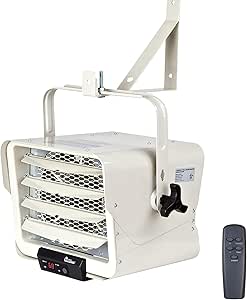 | Best for Larger Garages and Adjustable Output | Heating output: 4,700 or 7,500 watts | Voltage: 240 volts | Amperage: 31.25 A | VIEW LATEST PRICE | See Our Full Breakdown |
| Dr. Infrared Heater DR-238 Indoor and Outdoor Carbon Infrared Heater |  | Best for Targeted Indoor-Outdoor Heat | Heating method: Carbon infrared | Heat settings: 900 W, 1,200 W, and 1,500 W | Voltage: 120 V, 60 Hz | VIEW LATEST PRICE | See Our Full Breakdown |
| InoKraft 7,500W Electric Garage Heater with NEMA 14-50P Plug |  | Best for Plug-Connected High-Output Heating | Power: 7,500 watts | Voltage: 240 volts | Amperage: 31.25 A | VIEW LATEST PRICE | See Our Full Breakdown |
| Buyplus 1500W Portable Electric Space Heater with Overheat Protection |  | Best Portable Heater for a Small Work Area | Power: 1,500 W | Heating technology: PTC ceramic | Heating modes: Fan only, 750 W, and 1,500 W | VIEW LATEST PRICE | See Our Full Breakdown |
| Shinic 2-Pack 120V Ceiling-Mounted Electric Garage Heater, 1500W/750W |  | Best for Two Work Zones | Quantity: 2 heaters | Voltage: 120V | Power: 750W or 1,500W per heater | VIEW LATEST PRICE | See Our Full Breakdown |
| TEMPWARE 7,500W Electric Garage Heater, 240V Hardwired, Ceiling Mount |  | Best for Thermostat-Controlled Heating | Power: 5,000W–7,500W | Voltage and amperage: 240V; 31.25A | Heat output: 25,590 BTU | VIEW LATEST PRICE | See Our Full Breakdown |
| Mr. Heater Big Maxx 50,000 BTU Ceiling-Mounted Forced-Air Heater |  | Best for Large Gas-Heated Garages | Heat output: 50,000 BTU | Listed coverage: Up to 1,667 sq. ft. | Fuel: Natural gas; NG-to-LP conversion kit included | VIEW LATEST PRICE | See Our Full Breakdown |
| VEVOR 10,000-Watt Electric Garage Heater with Remote |  | Best for High-Output Electric Heating | Power: 10,000W | Voltage and current: 240V; 41.67A | Heating output: 34,129 BTU | VIEW LATEST PRICE | See Our Full Breakdown |
| Omberr 4000W Electric Garage Heater, 240V, Graphene Heating, Hardwired |  | Best Compact Hardwired Heater | Power: 4,000W | Voltage and current: 240V; 16.6A | Heating element: Graphene | VIEW LATEST PRICE | See Our Full Breakdown |
| garage heater | Mounting | Power | Voltage |
|---|---|---|---|
| Comfort Zone 5000-Watt Fan-For | Ceiling mount | 5,000 watts | 240 volts |
| Dr. Infrared Heater DR-975 7,5 | Wall or ceiling; bracket included | — | 240 volts |
| Dr. Infrared Heater DR-238 Ind | Wall or ceiling | — | 120 V, 60 Hz |
| InoKraft 7,500W Electric Garag | Wall or ceiling | 7,500 watts | 240 volts |
| Buyplus 1500W Portable Electri | — | 1,500 W | — |
| Shinic 2-Pack 120V Ceiling-Mou | Ceiling mount | 750W or 1,500W per heater | 120V |
| TEMPWARE 7,500W Electric Garag | — | 5,000W–7,500W | — |
| Mr. Heater Big Maxx 50,000 BTU | Ceiling mount | — | — |
| VEVOR 10,000-Watt Electric Gar | Wall-mounted or hanging | 10,000W | — |
| Omberr 4000W Electric Garage H | Ceiling mount; adjustable mounting angle | 4,000W | — |
More Details on Our Top Picks
Comfort Zone 5000-Watt Fan-Forced Ceiling-Mount Garage Heater
The Comfort Zone 5000-Watt is a strong fit for buyers who want a permanent, space-saving heater without the higher output of a 7,500-watt model. Its ceiling mount keeps the floor clear for vehicles and workbenches, while the adjustable angle and louvers let you aim forced air toward a work area. Compared with the Dr. Infrared Heater DR-975, it offers fewer output options and no remote thermostat, but its simpler dual-knob controls may suit a garage where straightforward operation matters more than fine adjustments. The heavy-gauge steel body and automatic overheat shutoff add useful practical touches. The tradeoff is installation: this unit is hard-wired and requires 240 volts, so it is not a plug-in choice and may call for an electrician.
Pros:- Ceiling-mounted design preserves floor and wall space.
- Adjustable mounting angle and louvers help direct forced air.
- Heavy-gauge steel body is suited to demanding garage environments.
- Automatic overheat shutoff provides a safety measure.
Cons:- Hard-wired installation limits portability and may require professional work.
- Requires a 240-volt supply.
- Single 5,000-watt output offers less adjustment than the DR-975’s two settings.
Best for: Garage owners with a 240-volt circuit who want a fixed, ceiling-mounted heater that keeps floor space open and directs heat toward a work area.
Not ideal for: Renters or buyers who need portable, plug-in heating, or those who want a remote thermostat and multiple output settings.
- Power:5,000 watts
- Voltage:240 volts
- Mounting:Ceiling mount
- Heating method:Fan-forced
- Construction:Heavy-gauge steel
- Controls:Dual-knob thermostat with on/off control
- Airflow direction:Adjustable mounting angle and louvers
- Safety:Automatic overheat shutoff sensor and power indicator light
- Installation:Hard-wired
Our verdict“Choose the Comfort Zone for uncomplicated, fixed garage heating with directed airflow, provided your space has 240-volt hard-wiring.”
Dr. Infrared Heater DR-975 7,500-Watt 240-Volt Hardwired Garage Heater
For buyers who need more heat than a 5,000-watt unit can provide, the DR-975 stands out with selectable 4,700- and 7,500-watt output and coverage listed up to 800 square feet. A remote-controlled thermostat and five adjustable louvers make it easier to manage temperature and aim airflow than with the simpler Comfort Zone 5000-Watt. Its wall-or-ceiling mounting also gives more placement flexibility. The fully enclosed, thermally protected motor is permanently lubricated, a practical design detail for a fixed heater. This added control comes with a more demanding installation: it is hard-wired, has no included power cord, and calls for 8 AWG copper wiring. Buyers seeking a plug-in option should look instead at the InoKraft, though that model also needs a 240-volt connection and professional installation.
Pros:- Two output settings offer more flexibility than the Comfort Zone 5000-Watt.
- Remote-controlled thermostat covers a 50–85°F range.
- Wall or ceiling mounting and five louvers help adapt airflow to the space.
- Fully enclosed, thermally protected motor is permanently lubricated.
Cons:- Hard-wired installation requires 8 AWG copper wiring; no power cord is included.
- An optional external wall thermostat is sold separately.
- The listed 800-square-foot coverage depends on the space and conditions.
Best for: Owners of larger garages or workshops with a suitable 240-volt circuit who want two heat outputs, remote thermostat control, and wall-or-ceiling mounting.
Not ideal for: Buyers who need a plug-in heater, lack the specified wiring, or want a compact portable option for spot heating.
- Heating output:4,700 or 7,500 watts
- Voltage:240 volts
- Amperage:31.25 A
- Heating coverage:Up to 800 square feet
- Thermostat:Remote-controlled; 50–85°F
- Mounting:Wall or ceiling; bracket included
- Airflow control:Five adjustable louvers
- Recommended wiring:8 AWG copper wires
- Power connection:Hardwired; power cord not included
Our verdict“Pick the DR-975 when a larger garage needs adjustable high-output heating and remote control, and the required hard-wiring is available.”
Dr. Infrared Heater DR-238 Indoor and Outdoor Carbon Infrared Heater
The DR-238 serves a different garage-heating need than the fan-forced Comfort Zone and DR-975: it delivers carbon infrared heat rather than circulating warm air. That makes it a better match for warming people or a defined work zone, including covered outdoor areas, than for rapidly heating a whole garage. Its three settings—900, 1,200, and 1,500 watts—give more adjustment than the Buyplus portable ceramic heater, and wall or ceiling brackets keep it out of the way. The weather-resistant anodized aluminum body and IP55 rating support indoor and outdoor use. The compromise is lower output: it is not a substitute for the 5,000- or 7,500-watt forced-air models when broad garage heating is the goal. It also has no thermostat and needs corded 120-volt power.
Pros:- Three settings provide 900-, 1,200-, and 1,500-watt output choices.
- IP55 rating and anodized aluminum construction suit indoor and outdoor use.
- Wall and ceiling mounting brackets and a remote are included.
- Infrared heating targets people and nearby areas rather than relying on whole-room airflow.
Cons:- Lower output than the Comfort Zone 5000-Watt and DR-975 makes it a poor choice for whole-garage heating.
- No thermostat is included.
- Requires corded 120-volt power.
Best for: People who want directed infrared warmth at a garage workbench, patio, or other defined indoor-outdoor zone and have access to 120-volt power.
Not ideal for: Buyers trying to heat a large, cold garage evenly, or anyone who wants thermostat-controlled temperature rather than selectable power settings.
- Heating method:Carbon infrared
- Heat settings:900 W, 1,200 W, and 1,500 W
- Voltage:120 V, 60 Hz
- Amperage:12.5 A
- Mounting:Wall or ceiling
- Material:Anodized aluminum
- Dimensions:35 x 8 x 4 in
- Weight:8 lb
- Certification:ETL Listed
Our verdict“Choose the DR-238 for mounted, targeted infrared warmth in a garage zone or outdoor area, not as a high-output whole-garage heater.”
InoKraft 7,500W Electric Garage Heater with NEMA 14-50P Plug
The InoKraft 7,500W combines high-output forced air with a NEMA 14-50P plug and 8.2-foot cord, so it offers a different connection approach from the hard-wired DR-975. It is listed for spaces up to 750 square feet and adds a digital thermostat, high and low settings, ECO mode, and a timer. Wall or ceiling mounting, adjustable louvers, and five installation angle settings help direct heat without taking up floor space. For buyers who want more day-to-day control than the Comfort Zone’s dual-knob setup, this is the more feature-rich choice. The tradeoff is that a plug does not make installation casual: the heater uses 240 volts, and the product information recommends a professional electrician. Its mode descriptions also mention both two speeds and three modes, so the control terminology is not entirely clear.
Pros:- 7,500-watt forced-air output is suited to larger spaces than the Buyplus or DR-238.
- Includes a digital thermostat, ECO mode, and a 1–24-hour timer.
- Cord and NEMA 14-50P plug avoid the DR-975’s hardwired-only connection.
- Wall or ceiling mounting and adjustable louvers help keep floor space open and direct airflow.
Cons:- Requires 240-volt power and professional electrician installation is recommended.
- The product information is inconsistent about two speeds versus high, low, and ECO modes.
- Listed coverage is up to 750 square feet, less than the DR-975’s stated coverage.
Best for: Garage and workshop owners with a compatible 240-volt NEMA 14-50 outlet who want 7,500-watt forced air plus timer and thermostat controls.
Not ideal for: Buyers without compatible 240-volt service, those seeking a small portable spot heater, or anyone who wants unambiguous mode specifications.
- Power:7,500 watts
- Voltage:240 volts
- Amperage:31.25 A
- Heating coverage:Up to 750 sq. ft.
- Temperature range:40°F–99°F
- Power connection:NEMA 14-50P plug; 8.2-foot cord
- Mounting:Wall or ceiling
- Modes and timer:High, low, and ECO; 1–24 hours
- Safety:Overheat protection and automatic shutoff
Our verdict“Choose the InoKraft for high-output garage heating with onboard scheduling and a plug connection, if your electrical setup is compatible.”
Buyplus 1500W Portable Electric Space Heater with Overheat Protection
Unlike the mounted, 240-volt Comfort Zone and InoKraft, the Buyplus 1500W is a portable ceramic heater for a small area rather than a whole garage. Its fan-only, 750-watt, and 1,500-watt modes let buyers choose between moving air and two heat levels, while the carry handle makes it easy to shift between a bench and another nearby spot. The listed coverage is up to 200 square feet, though real results will depend on the space and conditions. A self-resetting overheat feature, non-slip base, and stated noise level under 40 dB add convenience for close-range use. Compared with the DR-238, it is easier to move and offers ceramic fan heat, but it lacks that model’s indoor-outdoor rating and mounting hardware. It is not a replacement for a high-output garage heater.
Pros:- Portable handle and non-slip base support repositioning and stable placement.
- Fan-only, 750-watt, and 1,500-watt modes offer simple output choices.
- Self-resetting overheat protection is included.
- Specified operating noise is less than 40 dB.
Cons:- 1,500-watt output is far below the Comfort Zone 5000-Watt and other fixed garage heaters.
- Listed coverage of up to 200 square feet limits its role in larger garages.
- Requires an AC power source and needs a suitable nearby placement area.
Best for: DIYers who need movable supplemental heat at a workbench or in a small, enclosed garage area with an AC outlet nearby.
Not ideal for: Owners of large or poorly insulated garages who need even, whole-space heating or a permanently mounted 240-volt unit.
- Power:1,500 W
- Heating technology:PTC ceramic
- Heating modes:Fan only, 750 W, and 1,500 W
- Coverage area:Up to 200 sq. ft.
- Noise level:Less than 40 dB
- Safety feature:Self-resetting overheat protection
- Cord length:7.8 ft
- Dimensions:12 x 10 x 8 in (D x W x H)
- Power source:AC
Our verdict“Pick the Buyplus for portable supplemental warmth near a workbench, but choose a 240-volt mounted model for heating a full garage.”
Shinic 2-Pack 120V Ceiling-Mounted Electric Garage Heater, 1500W/750W
The Shinic two-pack suits garages where people work at separate benches or need heat aimed at specific areas. Each ceiling-mounted unit offers 750W or 1,500W of radiant heat, and its quartz tubes warm people and objects in front of it rather than trying to heat all the air in the room. That makes it a different kind of choice from the fan-forced Omberr GHA40, which spreads heat through airflow from a single hardwired unit. Shinic adds a useful halogen work light, five heat and light modes, and 90-degree rotation, while the pair saves floor space. The tradeoff is limited reach: radiant warmth is directional, and two ceiling installations may be more work than a plug-in heater. Choose it for focused task heat, not whole-garage warmth.
Pros:- Two heaters can serve separate benches or work zones.
- Radiant quartz tubes deliver direct warmth to people and objects.
- Built-in halogen work lights add visibility at the heater locations.
- Rotates up to 90 degrees and includes overheat shutoff and a grounded plug.
Cons:- Directional radiant heat does not warm the whole room evenly.
- Ceiling mounting takes more setup than a portable or plug-in heater.
Best for: DIYers with two distinct work areas who want ceiling-mounted radiant heat and task lighting without using floor space.
Not ideal for: People who need even warmth throughout a large garage or want a portable, plug-in heater; these units need ceiling installation and heat mainly in the direction they face.
- Quantity:2 heaters
- Voltage:120V
- Power:750W or 1,500W per heater
- Heating element:Dual quartz tubes
- Mounting:Ceiling mount
- Adjustability:Rotates up to 90 degrees
- Lighting and controls:Halogen work light; 5 heat and light modes
- Safety:Overheat auto-off; 3-prong grounded plug; ETL Listed
Our verdict“Choose the Shinic pair for two localized work zones with task lighting, but skip it if your priority is whole-garage air heating.”
TEMPWARE 7,500W Electric Garage Heater, 240V Hardwired, Ceiling Mount
The TEMPWARE GR7500ER-EC is a strong fit for buyers who want substantial electric output with more control than a basic dial thermostat. Its 5,000W–7,500W settings, digital temperature adjustment, ECO mode, remote, and 12-hour timer make it easier to tailor heating to a work session than the simpler Omberr GHA40, which is a lower-output 4,000W option. TEMPWARE lists coverage up to 1,250 square feet, but that figure does not replace checking your garage’s insulation and electrical capacity. The main hurdle is installation: this is a 240V hardwired heater, draws 31.25 amps, and requires a qualified electrician; no power cord is supplied. Pick it for a fixed, well-equipped workspace, not for a quick DIY setup or a garage without suitable wiring.
Pros:- Three output settings span 5,000W to 7,500W.
- Digital thermostat, ECO mode, touch controls, and remote provide flexible operation.
- 12-hour timer supports scheduled heating.
- Steel construction, ceiling bracket, and automatic overheat protection.
Cons:- Requires 240V hardwiring and installation by a qualified electrician.
- A power cord is not included.
- Its 31.25A draw may rule it out where electrical capacity is limited.
Best for: Garage owners with a suitable 240V circuit who want adjustable high-output heat, thermostat control, and remote operation for regular workshop use.
Not ideal for: Renters, casual users, or anyone seeking a plug-in installation; hardwiring and professional electrical work are required.
- Power:5,000W–7,500W
- Voltage and amperage:240V; 31.25A
- Heat output:25,590 BTU
- Listed coverage:Up to 1,250 sq. ft.
- Temperature range:45°F–95°F
- Controls and timer:Digital touch panel, remote, ECO mode; 12-hour timer
- Mounting and installation:Ceiling mount; hardwired; professional electrician required
- Safety:Automatic overheat protection
Our verdict“Choose TEMPWARE for controlled, high-output electric heating when your garage can support a professionally installed 240V circuit.”
Mr. Heater Big Maxx 50,000 BTU Ceiling-Mounted Forced-Air Heater
For a large garage or barn with gas service, the Mr. Heater Big Maxx brings a different scale of heating from the electric models in this roundup: its 50,000 BTU forced-air output is listed for spaces up to 1,667 square feet. Compared with the 10,000W VEVOR, it avoids relying on a high-amperage 240V electric circuit, but it adds gas supply and venting requirements instead. The included conversion kit supports natural gas or LP, and the unit can vent vertically or horizontally; compatible 24V and Wi-Fi thermostats are sold separately. Its substantial size and strict clearance needs matter: installation calls for a ceiling at least 10 feet high and 8 feet of clearance below the heater. It is a poor match for low-ceiling garages or buyers seeking a simple electric installation.
Pros:- 50,000 BTU forced-air output is suited to larger spaces.
- Includes an NG-to-LP conversion kit and ceiling-mount brackets.
- Supports vertical or horizontal venting.
- High-temperature shutoff and flame-sensing gas safety shutoff.
Cons:- Requires a ceiling at least 10 feet high and 8 feet of clearance below the unit.
- Compatible thermostats are sold separately.
- Gas supply, venting, and 120V AC power add installation requirements.
Best for: Owners of large garages, barns, or workshops with gas service, adequate ceiling height, and the ability to install the required venting.
Not ideal for: Small garages, low-ceiling spaces, or buyers who want an electric heater without gas-line and venting requirements.
- Heat output:50,000 BTU
- Listed coverage:Up to 1,667 sq. ft.
- Fuel:Natural gas; NG-to-LP conversion kit included
- Heating method:Forced air
- Mounting:Ceiling mount
- Power requirement:120V AC
- Venting:Vertical or horizontal
- Clearance:Minimum 10 ft ceiling; 8 ft below heater
- Thermostat compatibility:Standard 24V or Wi-Fi-enabled thermostats, sold separately
Our verdict“Choose the Big Maxx for a high-ceiling, gas-equipped large space; choose an electric model such as VEVOR if gas installation is not practical.”
VEVOR 10,000-Watt Electric Garage Heater with Remote
The VEVOR 10,000W heater is the electric pick here for buyers who need more output than a 7,500W unit can offer and have the wiring to support it. It delivers a listed 34,129 BTU and covers up to 90 square meters, while remote control, two power levels, adjustable louvers, and a 9-hour timer help direct and schedule the heat. Compared with the TEMPWARE 7,500W, VEVOR raises the available wattage but calls for a heavier electrical setup: its 240V draw is 41.67A, and the description specifies a breaker rated at least 42A. That makes electrical capacity the deciding factor, not just room size. Its hardwired installation and indoor-only rating also narrow its appeal. Choose it for a fixed workshop with suitable wiring, not a portable or low-demand space.
Pros:- 10,000W output provides more electric heating capacity than the 7,500W TEMPWARE.
- Two power levels and adjustable louvers help direct heat.
- Remote control and a 9-hour timer simplify operation.
- ETL listed, with overheat protection and automatic fan delay.
Cons:- Requires 240V hardwiring and a breaker rated at least 42A.
- For indoor use only.
- Remote control batteries are not included.
Best for: Owners of larger indoor garages or workshops with a suitable 240V circuit and at least 42A breaker capacity who want high-output electric heat.
Not ideal for: Buyers with limited electrical capacity, anyone needing an outdoor-rated heater, or people who want plug-in installation.
- Power:10,000W
- Voltage and current:240V; 41.67A
- Heating output:34,129 BTU
- Listed coverage:90 sq. m.
- Power levels:2
- Mounting:Wall-mounted or hanging
- Controls and timer:Remote control; 9-hour timer
- Safety and certification:Overheat automatic power-off; ETL listed
Our verdict“Choose VEVOR when your workshop needs high-output electric heat and has the circuit capacity; otherwise, the lower-demand TEMPWARE is a more manageable fit.”
Omberr 4000W Electric Garage Heater, 240V, Graphene Heating, Hardwired
The Omberr GHA40 takes the lower-output, space-conscious route among the hardwired electric options. At 4,000W and 13.3 pounds, it is a more compact ceiling-mounted choice than the 7,500W TEMPWARE or 10,000W VEVOR, which makes it a better fit when a large unit would be unnecessary or difficult to place. Its graphene heating element, adjustable louvers, and angled mounting let you direct airflow toward a bench or work area; the remote and timer add convenient control once it is installed. This is still a 240V hardwired heater with no plug, so compact size does not mean simple setup. Its maximum temperature setting is listed as 95°F, and its lower power is less suited to a large, poorly insulated garage than the higher-output VEVOR.
Pros:- Compact 13.3-pound unit uses less space than the higher-output VEVOR and TEMPWARE.
- Adjustable louvers and mounting angle direct airflow toward a work area.
- Remote control and a 0.5–9-hour timer add operating flexibility.
- Overheat protection stops heating while the fan continues cooling the unit.
Cons:- Requires a 240V hardwired connection and has no plug.
- Its 4,000W output is a weaker fit for large or poorly insulated garages.
- Designed for indoor use only.
Best for: Owners of smaller or moderately sized indoor garages and tool rooms who want a compact, fixed 240V heater with adjustable airflow and remote control.
Not ideal for: People needing a plug-in heater or high-output heating for a large, poorly insulated space; it requires hardwiring and provides less power than VEVOR or TEMPWARE.
- Power:4,000W
- Voltage and current:240V; 16.6A
- Heating element:Graphene
- Mounting:Ceiling mount; adjustable mounting angle
- Temperature setting range:40°F–90°F
- Maximum temperature:95°F
- Louver adjustment:0–130 degrees
- Timer and control:Remote control; 0.5–9 hours
- Installation:240V hardwired; no plug
Our verdict“Choose Omberr for compact, directed heat in a smaller indoor workspace, but select a higher-wattage unit if your garage needs more heating capacity.”

How We Picked
I compared these heaters by the job a buyer needs them to do: warming an enclosed garage, taking the chill off one work area, or supplying heat where a fixed unit is not practical. I weighed heating output and delivery style alongside installation needs, including voltage, hardwiring, plug type, mounting, and the practical demands of gas service. Those details affect not just setup, but also whether a heater can provide useful coverage in a given space.
The ranking favors options with a clearer path to dependable garage heating and a stronger balance of output, usability, and fit. The DR-975 leads as a substantial hardwired electric choice; the InoKraft follows for shoppers with the right 240-volt receptacle, while the Big Maxx stands out for buyers prepared for gas installation. Targeted infrared and lower-output portable models rank lower for whole-garage use, but remain relevant for narrower jobs. I also treated missing details as a reason for caution rather than assuming every high-wattage heater suits every garage.
| garage heater | Mounting |
|---|---|
| Comfort Zone 5000-Watt Fan-For | Ceiling mount |
| Dr. Infrared Heater DR-975 7,5 | Wall or ceiling; bracket included |
| Dr. Infrared Heater DR-238 Ind | Wall or ceiling |
| InoKraft 7,500W Electric Garag | Wall or ceiling |
| Buyplus 1500W Portable Electri | — |
| Shinic 2-Pack 120V Ceiling-Mou | Ceiling mount |
| TEMPWARE 7,500W Electric Garag | — |
| Mr. Heater Big Maxx 50,000 BTU | Ceiling mount |
| VEVOR 10,000-Watt Electric Gar | Wall-mounted or hanging |
| Omberr 4000W Electric Garage H | Ceiling mount; adjustable mounting angle |
Factors to Consider When Choosing Best Garage Heaters
Choosing a garage heater starts with the space and how you use it, not with the largest wattage on a product page. I would work through these factors before choosing a model, since electrical capacity, heat distribution, and installation can change which options are realistic.
Match Output to the Space and the Job
Garage size is only part of the sizing question: ceiling height, insulation, air leaks, and how cold the space gets all affect the heat needed. A heater that is adequate for a small insulated garage may struggle in a drafty, tall, or frequently opened workspace. Decide whether you need the whole garage comfortable or only a warm spot at a bench; those are different jobs and can call for very different output. Avoid treating wattage or BTU as a direct promise of a particular room temperature, since conditions and heater placement matter. If the garage is poorly insulated, sealing gaps and improving insulation may do more for comfort than stepping up to a more powerful unit. When sizing remains uncertain, use the manufacturer’s coverage guidance and have an electrician or qualified installer check that the proposed setup suits the space.
Check Electrical Service Before Choosing an Electric Model
High-output electric garage heaters often need 240-volt service, and some require hardwiring or a dedicated circuit. A plug-in model is not automatically ready to use: its receptacle, circuit, and plug configuration must match, and a suitable outlet may need professional installation. Check the garage’s electrical panel capacity and the heater’s installation instructions before buying. Do not rely on an extension cord or adapter to bridge a mismatch unless the manufacturer explicitly permits that setup. Lower-wattage 120-volt heaters ask less of the electrical system, but their limited output makes them a poor substitute for a whole-garage unit. The real tradeoff is convenience now versus the output and permanent setup needed for regular heating.
Choose How Heat Should Reach You
Fan-forced heaters warm and circulate air, which can suit an enclosed garage where you want heat to spread beyond one spot. Infrared heaters direct warmth toward people and nearby surfaces, so they can feel useful in a work zone without first heating all the air. That targeted effect can be an advantage in a drafty space or when the heater is used intermittently, but it does not make infrared the best choice for uniform room warmth. A ceiling-mounted heater can keep floor and bench space clear, while a portable unit can be repositioned but takes up space and may need careful placement. Think about where you stand, whether doors are often open, and whether you need broad circulation or immediate personal warmth. The delivery method can matter as much as the headline output.
Treat Installation and Venting as Part of the Purchase
A ceiling-mounted heater needs a suitable mounting surface, clearance from surrounding materials, and a location that directs heat where it is useful. Hardwired models add electrical work, so installation cost and scheduling belong in the decision even when they are not part of the heater itself. Gas models bring a separate set of needs, including an appropriate fuel connection and exhaust venting as specified by the manufacturer. Do not assume a gas heater can be used safely in any garage simply because it is mounted overhead. Read the installation manual before selecting a spot, and check local requirements or hire a qualified professional when the work involves wiring, gas, or venting. A simpler heater that fits your existing setup may be a better buy than a more powerful model that requires major alterations.
Pay for Capacity You Can Actually Use
Higher output is valuable when a large or cold garage needs regular heating, but it can be wasted on a small space or occasional task. A premium hardwired model makes more sense for frequent use when the electrical service and installation plan are already in place. For a workbench or short visits, a compact personal heater may meet the need with less setup, even if it cannot heat the full garage. Features such as a thermostat, remote control, and selectable output can make day-to-day use easier, but they do not compensate for inadequate coverage or an unsuitable circuit. Compare the full cost of ownership, including installation, fuel where applicable, and likely operating time, rather than choosing by initial price alone. Spend more when the extra capacity or control solves a real problem; otherwise, a focused heater can be the more sensible fit.
Build Safety and Air Quality Into the Decision
Garages contain tools, stored materials, vehicles, and sometimes fuels or solvents, so placement and clearance deserve careful attention. Follow the manufacturer’s stated distances from walls, ceilings, objects, and combustible materials, and keep airflow paths unobstructed. Never choose a heater based on assumptions about safe operation around flammable vapors; check the manual and local safety guidance for the exact model and setting. Fuel-burning heaters require particular attention to ventilation and exhaust, while electric models still need correct wiring and suitable mounting. If the garage is attached to a home, account for how air movement and exhaust could affect adjacent living areas. A qualified installer can help resolve questions about electrical loads, mounting, and venting before the heater is put into service.
Frequently Asked Questions
Can I plug a 7,500-watt garage heater into a regular wall outlet?
No: a typical 120-volt household outlet is not the connection for a 7,500-watt, 240-volt heater. A plug-in model such as the InoKraft still needs a compatible NEMA 14-50 receptacle and an appropriately rated circuit. A hardwired model, such as the DR-975 or TEMPWARE, needs the electrical work specified by its manufacturer. Check the heater’s manual and have an electrician confirm the circuit and panel can support it before purchase. Do not use an adapter or extension cord to make an incompatible outlet appear suitable.
Is a 50,000-BTU gas heater a better choice than a 7,500-watt electric heater?
Not automatically; the better option depends on the garage, available utilities, and installation requirements. The Mr. Heater Big Maxx offers a different heating scale and fuel source, which can appeal in a larger space where gas service and proper venting are available. A 7,500-watt electric unit may be a more natural fit for a buyer with sufficient 240-volt service who prefers electric operation. Compare the manufacturer’s coverage guidance, required clearances, and installation plans rather than treating BTU and wattage figures as directly interchangeable. If gas supply or venting would be difficult, the extra output may not justify the added complexity.
Will an infrared heater warm my whole garage?
Infrared heat is generally more suited to warming people and surfaces in its path than evenly raising the temperature of all the air in a garage. The DR-238 is better understood as a targeted option for a particular zone, especially where localized warmth is more useful than whole-room heating. For a broader enclosed space, a fan-forced heater may distribute warmth more effectively. Open doors, drafts, and obstructions can further limit how much area feels warm. Choose infrared when direct warmth is the priority, not because its listed output guarantees whole-garage coverage.
Are 1,500-watt heaters enough to heat a garage in winter?
They may take the chill off a small, insulated area or warm someone near the heater, but they are generally a limited choice for heating an entire garage in cold weather. The Buyplus and Shinic are 120-volt, lower-output options compared with the 240-volt models in this lineup. Garage size, insulation, outdoor temperature, and door use all affect what they can achieve. For a whole-garage goal, compare higher-output models and first confirm that the electrical service supports them. For occasional bench work, a smaller heater can still be a practical choice if expectations stay local.
Should I install a garage heater myself or hire a professional?
That depends on the heater’s installation requirements and your qualifications, but hardwired 240-volt units and gas heaters commonly call for professional help. Electrical work must match the circuit, panel capacity, and manufacturer instructions; gas models also require suitable fuel connections and venting. Even a plug-in unit needs a correctly rated receptacle and safe mounting or placement. Read the complete installation manual before buying so the work and clearances are clear in advance. When in doubt, ask a qualified electrician or gas installer to inspect the proposed setup.
Conclusion
For the strongest all-around electric fit in this group, I would start with the Dr. Infrared Heater DR-975, provided the garage can support its hardwired 240-volt installation. The InoKraft 7,500W is my value-oriented pick for buyers who already have the right NEMA 14-50 outlet, while the Mr. Heater Big Maxx is the premium-capacity choice for a larger garage with suitable gas service and venting. Beginners who want a simpler, localized option can look at the Buyplus 1500W, though it is not a whole-garage solution. For targeted warmth, consider the DR-238 infrared heater; for a compact ceiling-mounted setup, the Shinic two-pack offers a different low-output approach. I would choose only after matching the heater’s output and installation needs to the actual garage, rather than paying for capacity the space cannot use.