TL;DR

Get home appliances delivered free — and shop member deals
- Fast, free delivery on millions of items
- Access to Prime Big Deal Days deals on October 6–7
- Prime Video, Amazon Music and more included
A Livingetc report describes renewed interest among British interior designers in traditional Swedish ceramic stoves, also known as kakelugnar. Designers and a stove-company director say the stoves can release heat for 12 to 24 hours after one burn, though costs, installation needs and emissions depend on the model and fuel.
Traditional Swedish ceramic stoves are appearing in more British interior projects, according to a Livingetc report, as designers point to their capacity to store heat and serve as a room’s focal point. The report says a single hot burn can provide 12 to 24 hours of heat, but it does not offer independent performance data or establish that every model meets local emissions rules.
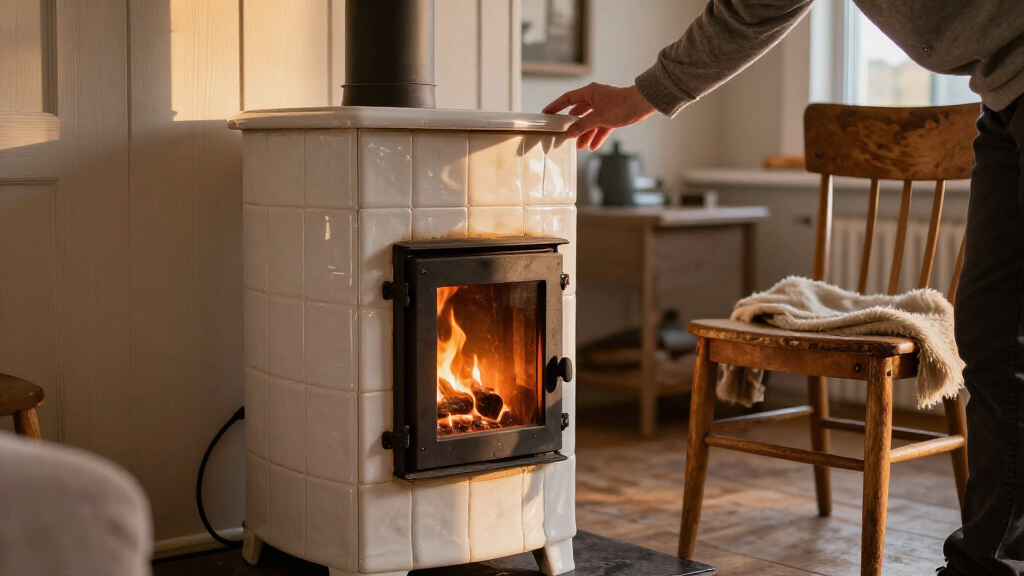
Known in Swedish as kakelugnar and in German as kachelofen, these tiled stoves have a long history in northern Europe. Unlike an open hearth, a ceramic stove is designed to absorb heat from a hot fire and release it gradually. Alan Hills, director of The Ceramic Stove Company, told Livingetc that this allows a household to use fewer logs than with a conventional wood burner. The report does not specify the size or conditions of the comparison.
Interior designer Henri Fitzwilliam-Lay described the stoves as both efficient sources of heat and decorative objects. Their ceramic tiles can be patterned or custom-coloured, giving them a prominent place in a room. The report cites installations by designers including Adam Bray, Beata Heuman and Veere Grenney, alongside projects by AOR Architects, Olivia Outred and AIYA Bureau.
Installation methods vary. Outred told the publication that a stove in an east London terrace was assembled in the room: a brick structure was built first, then curved tiles were applied. The project used a gas-fitted model to meet the designers’ stated need to comply with London air-quality controls. Hills advised planning installation after wet trades, such as plastering, are complete; some units may also need a reinforced base. The report says modular stoves can be assembled in a couple of days.
Heat Storage Meets Interior Design
The appeal is practical as well as visual: a stove that releases stored heat over many hours may offer a different heating pattern from an open fire, which sends much of its heat up the chimney. That prospect matters to homeowners weighing comfort, fuel use and the appearance of a heating appliance. However, the Livingetc report provides no measured comparison of fuel consumption, emissions or running costs, so its efficiency claims should be understood as attributed statements, not a universal guarantee.
Price and installation may limit who can choose one. Livingetc says prices start at several thousand pounds, while the total cost will depend on the unit and work required. The report presents the stoves as long-lasting investments, but does not provide product lifespan data or a payback calculation. Local rules also matter: the gas-fired example shows that a traditional appearance does not necessarily mean a wood-burning installation.
As an affiliate, we earn on qualifying purchases.
From Northern Europe to British Homes
Livingetc frames the stoves as a familiar feature of northern European homes that is gaining attention in British design. The report contrasts their heat-storage construction with the open fires more commonly associated with British hearths. It also notes that ceramic stoves have appeared as background features in films, while designers are now using them as central decorative elements.
The projects show a range of approaches rather than one standard style. AOR Architects chose a custom pink Drottningholm stove for Villa Luella, while Outred selected a Karl-Johan model for a London home where the stove could occupy a corner without blocking windows. Other examples include a green-tiled stove in an apartment designed by AIYA Bureau and a terracotta model made by ceramicist Jessica Steinhäuser for designer Colette van den Thillart’s Ontario project. These are individual commissions, not evidence of market-wide adoption.
“Ceramic stoves work by generating heat for 12 to 24 hours from one hot burn, using far fewer logs than a conventional wood burner.”
— Alan Hills, director of The Ceramic Stove Company, speaking to Livingetc
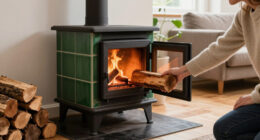
traditional tiled wood-burning stove
As an affiliate, we earn on qualifying purchases.
As an affiliate, we earn on qualifying purchases.
Performance and Rules Vary
The report does not provide independent tests supporting the stated 12-to-24-hour heat output, nor does it quantify emissions or compare fuel use with a conventional stove under matching conditions. Hills told Livingetc that the hotter fire burns particulates in the firebox and produces fewer emissions, but the article gives no test results, certification details or model-specific figures. Those claims should not be applied automatically to every ceramic stove.
It is also unclear how much installations typically cost beyond the stated starting price, what maintenance is required, or whether a particular unit can be installed in a given home. Rules differ by location and fuel type. The London example was gas-fitted; the report does not establish that wood-burning ceramic stoves are permitted everywhere or explain the applicable requirements for each project.
As an affiliate, we earn on qualifying purchases.
Check Costs Before Installing
Anyone considering a ceramic stove will need to check the chosen model’s fuel, tested performance and emissions information, along with local air-quality and building requirements. Installation planning should account for the stove’s weight, the condition of the floor and the sequence of other renovation work. Hills’ advice to wait until plastering and other wet trades are finished is specific guidance attributed to the company director, not a substitute for a site assessment.
Livingetc’s report does not announce a new product launch or a formal change in regulations. The development it documents is a design trend: more British interiors are using a centuries-old stove form for both heating and visual effect. Whether interest grows beyond individual projects will depend on costs, installation constraints and evidence about real-world performance.
custom-colored ceramic stove tiles
As an affiliate, we earn on qualifying purchases.
As an affiliate, we earn on qualifying purchases.
Key Questions
What is a Swedish ceramic stove?
A Swedish ceramic stove, or kakelugn, is a tiled heating appliance designed to absorb heat from a fire and release it gradually. The Livingetc report describes it as a longstanding northern European form now appearing in British interior projects.
How long can one burn provide heat?
Alan Hills of The Ceramic Stove Company told Livingetc that a single hot burn can generate heat for 12 to 24 hours. The report does not include independent tests or clarify how performance varies by model, fuel or home.
Are ceramic stoves more efficient than open fires?
Hills and designer Henri Fitzwilliam-Lay describe them as efficient, and Hills says they use fewer logs than conventional wood burners. Livingetc does not provide a controlled comparison or measured emissions data, so performance should be checked for the specific appliance.
How much does a ceramic stove cost?
Livingetc says prices start at several thousand pounds. It does not give a typical total installation cost, which may vary with the model, the building and any work needed to support or connect the stove.
Can a ceramic stove be installed in any home?
Not necessarily. The report says some models may need a reinforced base and that fuel and air-quality rules affect installation choices. Homeowners should check local requirements and suitability for their property before selecting a model.
Source: rss
Fall yard work Picks
leaf blowers
As an affiliate, we earn on qualifying purchases.