
TL;DR

Get home appliances delivered free with Prime
- Fast, free delivery on millions of items
- Prime Video, Amazon Music and more included
- Member-only deals all year
A Veranda report outlines advice from interior designers Kate Marker and Jessica Kain Barton on lighting dressing rooms with a mix of decorative ceiling fixtures and face-level task lighting. They recommend warm bulbs for general use, brighter color-rendering light at a vanity, and dimmers for adjustable illumination.
A Veranda report on dressing-room design recommends combining decorative ceiling lights with task lighting near mirrors, rather than relying on recessed fixtures alone. Interior designers Kate Marker and Jessica Kain Barton say layered, warm light can support everyday tasks while making a dressing room feel more personal.
Marker, an interior designer who recently released a lighting collection with Mitzi of Hudson Valley Lighting Group, describes a dressing room as a private space to begin and end the day. She advises using both ambient and task lighting so the room feels welcoming but remains practical. For overhead illumination, she favors a decorative pendant or petite chandelier that can serve as a visual focal point.
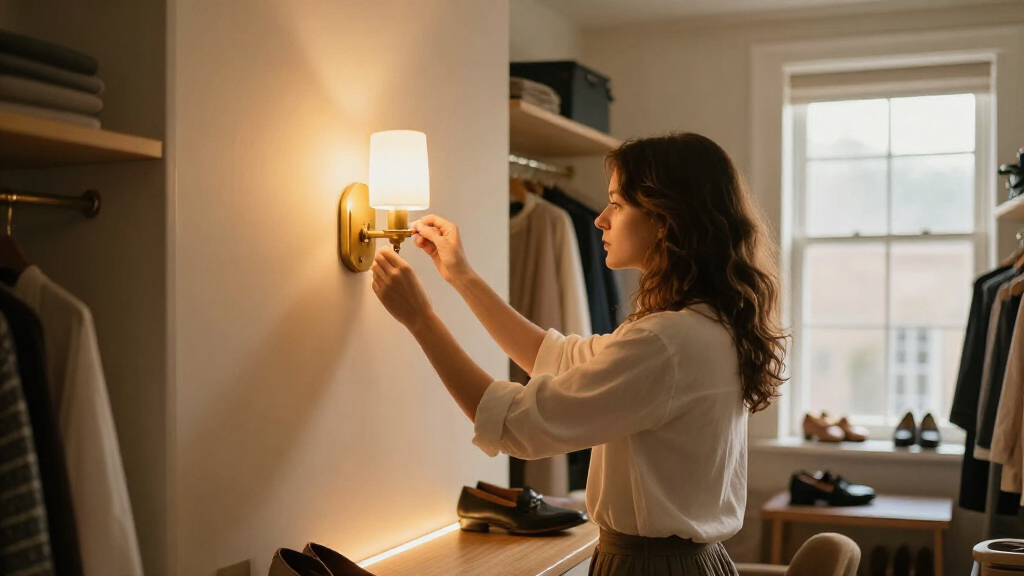
Barton, of Louisville-based J. Kathryn Interiors, also recommends a chandelier, lantern or flush-mount fixture. She says overhead fixtures should have at least three or four candle bulbs to provide adequate light. Both designers suggest adding smaller fixtures at face level: Marker favors sconces beside a mirror, while Barton points to small library sconces near a makeup vanity.
The report gives specific guidance on light color and control. Marker and Barton use 2700K bulbs for a softer general glow; Marker recommends 3000K bulbs with strong color rendering for vanity lighting. She also advises putting decorative fixtures on dimmers, which let occupants adjust the room’s brightness and mood.
Lighting for Mirrors and Daily Tasks
The recommendations address a practical problem in a compact room: a ceiling light may illuminate the space but still cast shadows across the face. Marker says face-level sconces help reduce those shadows, which matters when applying makeup or choosing clothing. Pairing them with general room lighting gives users more than one useful light level.
The advice also distinguishes between making a room attractive and making it work well. A decorative fixture can add character, while well-placed task lighting supports grooming and dressing. Dimmers add flexibility, allowing occupants to lower the brightness when they want a softer atmosphere and raise it when they need clearer visibility.
Color temperature is another consideration for people selecting bulbs or planning a renovation. The designers’ suggested 2700K and 3000K options are recommendations from the report, not a guarantee that every fixture or room will produce the same result. Light quality also depends on placement, fixture design and the bulb’s color-rendering performance.
Products Worth Considering

Philips Hue White and Color Ambiance Smart Light Starter Kit, 2 A19 Bulbs with Hub

Philips Hue Secure Starter Kit with Contact Sensors, Motion Sensor, Bridge, and Color Smart Bulbs

Hisense 65-inch U6 Pro Mini-LED 4K UHD Smart Fire TV
As an affiliate, we earn on qualifying purchases.
A Private Room With Practical Needs
The report places today’s dressing rooms in a longer history of private spaces for dressing and personal routines. It says dressing rooms, known as boudoirs in France, appeared in English and European homes during the 17th century and served as private rooms for dressing, correspondence and conversation. The article notes that their purpose has not changed entirely, though their decoration and lighting have.
That mix of privacy and daily use shapes the designers’ approach. Marker describes the desired feeling as a personal boutique, while Barton says she prefers to keep the lighting warm and simple. Their suggestions combine decorative fixtures with practical illumination instead of treating the room as either a purely functional closet or a display space.
The report also recommends treating materials and furnishings as part of the room’s overall feel. Marker says fabric details and patinated brass can add softness and warmth. Barton mentions mirrors integrated into cabinetry or placed behind doors, along with an antique mirror for a vanity. These are design ideas from the two professionals, not requirements for a well-lit room.
““My biggest must-do [when decorating a dressing room] is layering lighting. You want a combination of ambient and task lighting so the room feels warm and inviting but is still functional.””
— Kate Marker, interior designer
Room Layouts Affect the Right Setup
The report does not prescribe a lighting plan for every room. It provides designers’ preferences, but the right fixture count and placement depend on room dimensions, ceiling height, mirror locations, existing wiring and the amount of daylight. The source does not include measured lighting levels or comparative tests showing how one setup performs against another.
Its recessed-light guidance is also conditional. Marker cautions against relying on recessed lighting alone because she says it can feel harsh and cast unflattering shadows. When architectural constraints make recessed fixtures necessary, Barton recommends no more than four, preferably mud-in fixtures no wider than three inches. The report does not specify whether that limit applies to every room size or layout.
The designers’ color-temperature suggestions are not a substitute for checking the actual light source. The report does not name particular bulbs or define a color-rendering threshold for vanity lighting. Readers should also follow fixture and bulb specifications and consult a qualified electrician for electrical work.
Applying the Advice at Home
For homeowners planning a dressing-room update, the report’s recommendations suggest starting with the room’s tasks: identify where people dress, use mirrors or apply makeup, then plan ambient and face-level lighting around those locations. A decorative pendant, chandelier or flush mount can provide overhead light; sconces or vanity fixtures can supplement it where clearer face lighting is needed.
Before purchasing fixtures, check whether the room’s wiring supports the intended placement and whether selected fixtures can be used with dimmers. If recessed lighting is already installed or cannot be avoided, Barton’s suggestion offers one designer’s approach, but the report does not establish it as a universal standard. Changes to wiring or electrical fixtures should be handled by a licensed professional.
After installation, occupants can adjust the setup through bulb choice and dimming, while considering how the light looks at different times of day. The source offers no announced follow-up study or formal standard; its guidance remains a set of recommendations from two designers featured by Veranda.
Key Questions
What kind of overhead light do the designers recommend?
They suggest a decorative pendant, chandelier, lantern or flush mount. Barton recommends an overhead fixture with at least three or four candle bulbs; Marker says a decorative ceiling fixture can also act as a focal point.
Why add sconces beside a dressing-room mirror?
Marker says face-level sconces can reduce shadows around the face, making them useful near a mirror or vanity. The report does not specify a universal mounting height or spacing.
What bulb temperature does the report recommend?
Marker and Barton favor 2700K bulbs for general dressing-room lighting. For a vanity, Marker recommends 3000K bulbs with strong color rendering.
Should recessed lights be avoided?
Marker says not to rely on recessed lights alone because they can feel harsh and create shadows. If recessed fixtures are unavoidable, Barton suggests no more than four, preferably mud-in models no wider than three inches; the report does not present this as a universal code or standard.
Are dimmers recommended for dressing-room lights?
Yes. Marker recommends putting decorative lighting on dimmers so users can adjust the brightness to suit different activities and atmospheres.
Source: veranda.com