TL;DR

Get home appliances delivered free with Prime
- Fast, free delivery on millions of items
- Prime Video, Amazon Music and more included
- Member-only deals all year
A Hunker report describes using 3-IN-ONE Dry Lock Lube, purchased at Lowe’s, to resolve one household’s sticky door lock. The writer says the key moved freely after application, but that single experience does not establish that the product will fix every lock or replace professional service.
A Hunker writer reports that a roughly $7 can of 3-IN-ONE Dry Lock Lube bought at Lowe’s made a long-sticky door lock work smoothly after one application, offering a low-cost step to try before replacing hardware. The result is a single household test, not proof that the lubricant will fix every lock or that professional help is unnecessary.
The writer said the lock had been difficult to use for years: the key could be hard to insert, and the household avoided locking the knob. After a broken key led to an emergency locksmith call and later concerns about replacement, the writer contacted another locksmith. That locksmith suggested trying dry lock lubricant before paying for new hardware, according to the Hunker account.
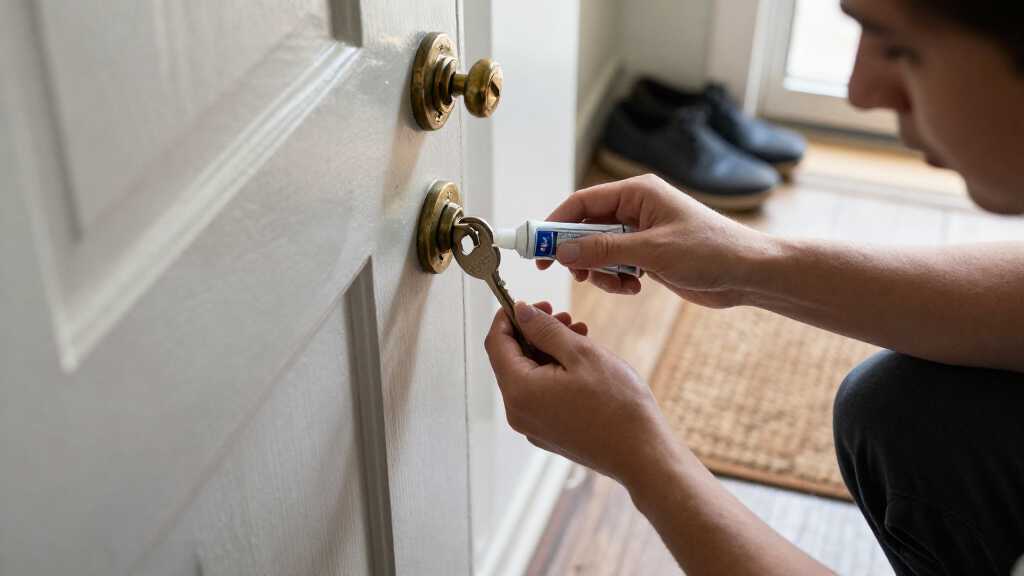
The writer used 3-IN-ONE Dry Lock Lube, applying it through the can’s narrow nozzle into the keyhole. The report says some liquid dripped out and appeared to dry within seconds. Afterward, the writer inserted the key and found that it moved freely. The account also describes applying the product to other household locks and outdoor padlocks, but gives no separate measurements or controlled comparison for those locks.
Hunker contrasts the product with WD-40, saying oil-based products may attract dust and debris over time and contribute to buildup inside a lock. The report describes the dry lubricant as graphite-free and says it leaves a film intended to repel dirt. Those are explanations in the source article; the account does not include independent testing or product-performance data.
A Low-Cost Step Before Replacement
For a homeowner dealing with a sluggish lock, the report points to a relatively inexpensive measure that may be worth trying before replacing functioning hardware. In the writer’s case, a brief application appeared to resolve the problem, avoiding an immediate replacement expense. The account does not establish how much a replacement would have cost or whether a locksmith would have charged to service the lock instead.
The practical distinction is between a lock that needs lubrication and one with a mechanical fault. If a key remains difficult to turn, the lock is damaged, or the problem returns, the Hunker test is not evidence that repeated spraying will solve it. A locksmith can assess whether the cylinder or other parts need repair or replacement. Readers should follow the lubricant label and apply it only as directed for the specific lock.
Products Worth Considering

Sonos Era 100 SL Compact Microphone-Free Speaker, Black

Bose Lifestyle Ultra Wireless Home Speaker

Roborock Qrevo S Pro Robot Vacuum and Mop
As an affiliate, we earn on qualifying purchases.
What the Locksmith Recommended
The Hunker account began with a recurring problem, not a product trial set up to compare brands. The writer had lived with a sticky lock for years and previously paid for emergency help after a key broke inside it. When the writer later asked a different locksmith about replacing the hardware, that locksmith recommended trying dry lock lubricant first.
The article’s alternative to WD-40 is a lubricant formulated for locks, rather than a general-purpose product. Hunker says dry lubricant can leave a protective film without the residue associated with some oil-based formulas. It also notes that graphite-based products may gum up older locks. The report does not specify the lock’s make, age, internal condition or the exact amount applied, details that limit how broadly its result can be applied.
“Try a quick, easy $7 solution from the hardware store first before spending money on his services.”
— The locksmith, as recounted by the Hunker writer
One Lock, No Controlled Test
The source describes one person’s experience and does not report a controlled test, independent product assessment or results across a range of lock types. It is unclear whether the same product would help locks that are sticky because of worn, bent or damaged components rather than dust or debris. The Hunker account also does not identify the lock model or provide a longer-term follow-up showing how long the improvement lasted.
The report does not establish that WD-40 causes problems in every lock or that dry lube is appropriate for every product. Lubricant formulations and manufacturer instructions can differ. A lock that still binds after an application, or a key that is bent or damaged, may need professional inspection rather than more lubricant.
Check the Lock After Application
Hunker suggests adding a quick lock check to seasonal or annual home maintenance, while saying its writer used the product on locks that had specific problems. The article does not provide a formal maintenance schedule supported by testing. For readers considering the same approach, the immediate next step is to check the product label and the lock manufacturer’s guidance, apply the lubricant as directed, and test the key gently.
If the lock remains difficult to operate or quickly becomes sticky again, contact a locksmith to identify the cause. The Hunker report does not announce further testing or a follow-up study, so whether this method works reliably across different locks remains unknown.
Key Questions
What product did the Hunker writer use?
The writer used 3-IN-ONE Dry Lock Lube, purchased at Lowe’s. The account describes it as a graphite-free dry lubricant designed for lock mechanisms.
Did the product fix the lock?
The writer said the key began moving freely immediately after application. That is a report of one household’s experience, not a guarantee for other locks.
Why does the report recommend dry lock lube instead of WD-40?
Hunker says some oil-based products can attract dust and debris inside a lock over time, while dry lock lubricant is intended to leave a less sticky film. The article does not provide an independent comparison test.
Should I replace a lock if it is sticky?
Not necessarily, but the report cannot diagnose a particular lock. Follow the lock and lubricant instructions; if the key still binds, the lock is damaged, or the problem returns, ask a locksmith to inspect it.
Source: hunker.com