Robotic window cleaning robots can reduce hands-on scrubbing, but the right choice depends on your windows, how much setup you will tolerate, and whether you value a self-cleaning station or a simpler machine. I rank the ECOVACS WINBOT W3 OMNI as the best overall pick for its self-cleaning station, while the WINBOT W2 PRO Omni stands out for buyers who want a multifunction station and the HUTT H10 for its dual-stage cleaning approach. The main tradeoffs are convenience versus carrying and maintaining extra equipment, and feature-rich controls versus straightforward operation. Spray coverage, edge access, suction, safety provisions, and window compatibility also separate these models. Read on for the full breakdown, comparison criteria, and advice on matching a robot to your glass.

Get home appliances delivered free with Prime
- Fast, free delivery on millions of items
- Prime Video, Amazon Music and more included
- Member-only deals all year
Complete the kit


Key Takeaways
The WINBOT W3 OMNI leads this lineup for buyers who value a self-cleaning station; that added equipment is a convenience feature, not a reason to ignore storage and setup needs.
WINBOT W2 PRO Omni and WINBOT W2S PRO serve different priorities: the former centers on a multifunction station, while the latter is a more direct robot-focused option.
Spray systems appear across several brands, including TOSIMA, Robo Clean, Tosima, BOJUK, KADSKAN, and AOQUFUL, so nozzle count alone does not establish better cleaning or window compatibility.
The two ECOVACS WINBOT MINI listings and the separate WINBOT MINI 2 make model identity worth checking carefully before purchase; similar names do not prove identical specifications.
Remote control, app control, and AI path planning are not interchangeable advantages: the best fit depends on whether a buyer values direct commands, phone-based operation, or automated route handling.
| ECOVACS WINBOT MINI Window Cleaning Robot |  | Best Compact Pick | Dimensions: 8.46 × 8.46 × 2.17 in | Suction power: 7500 Pa | Spray system: Dual ultrasonic spray nozzles | VIEW LATEST PRICE | See Our Full Breakdown |
| HUTT H10 Window Cleaning Robot with Dual-Stage Cleaning |  | Best for Wet-and-Dry Cleaning | Suction power: Up to 6500 Pa | Cleaning pressure: Up to 55 N (12.3 lbs) | Water tank: 80 ml | VIEW LATEST PRICE | See Our Full Breakdown |
| ECOVACS WINBOT W3 OMNI Robot Window Cleaner with Self-Cleaning Station |  | Best for Hands-Off Pad Care | Navigation: Win-SLAM 5.0 with dynamic obstacle avoidance | Spray system: Triple-nozzle wide-angle spray | Cleaning modes: Fast, Intensive, and Zone | VIEW LATEST PRICE | See Our Full Breakdown |
| ECOVACS WINBOT W2 PRO Omni Window Cleaning Robot with Multifunction Station |  | Best for Flexible Power Options | Power source: Battery powered; can also operate while plugged in | Battery life: Up to 110 minutes | Battery-mode coverage: Up to 55 square meters per full charge | VIEW LATEST PRICE | See Our Full Breakdown |
| ECOVACS WINBOT W2S PRO Window Cleaning Robot |  | Best for Edge-Focused Cleaning | Suction power: 10,000 Pa | Cleaning system: Triple-spray wet wiping with microfiber pad | Edge cleaning: TruEdge 2.0 | VIEW LATEST PRICE | See Our Full Breakdown |
| TOSIMA WA9C Pro Window Cleaning Robot with Dual Spray and Remote Control |  | Best for Spray Coverage and Manual Control | Model: WA9C Pro | Nozzle count: 4 | Suction force: 2,600–3,200 Pa | VIEW LATEST PRICE | See Our Full Breakdown |
| ECOVACS WINBOT MINI 2 Compact Window Cleaning Robot |  | Best for Small and Hard-to-Reach Glass | Dimensions: 8.46 × 8.46 × 2.17 inches | Minimum window size: 8.66 × 9.84 inches | Suction power: 8,000 Pa | VIEW LATEST PRICE | See Our Full Breakdown |
| Robo Clean Window Cleaning Robot with Dual Ultrasonic Spray |  | Best for Multiple Smooth-Surface Types | Maximum suction: 6,400 Pa | Water tank capacity: 85 ml | Spray system: Dual ultrasonic | VIEW LATEST PRICE | See Our Full Breakdown |
| Tosima X1 Window Cleaning Robot with Dual Ultrasonic Spray Nozzles | 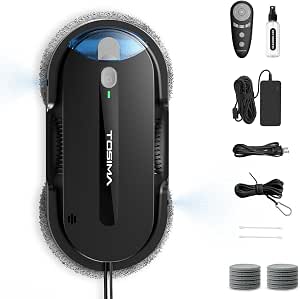 | Best for Straightforward S-Path Cleaning | Model: Tosima X1 | Water tank capacity: 85 ml | Cleaning path: S-shaped, top to bottom | VIEW LATEST PRICE | See Our Full Breakdown |
| BOJUK Window Cleaning Robot with 6500Pa Suction, Dual Spray, and Remote Control |  | Best for Strong Stated Suction and Simple Routes | Model: C260-M | Suction power: 6,500 Pa | Cleaning modes: Top-Down, Left-Down, and Right-Down | VIEW LATEST PRICE | See Our Full Breakdown |
| KADSKAN HCR-10 Window Cleaning Robot with Water Spray |  | Best for Manual Spray Control | Suction power: 5600 Pa | Cleaning modes: 3 automatic modes; manual directional control | Water spray: Automatic and manual | VIEW LATEST PRICE | See Our Full Breakdown |
| Automatic Window Cleaning Robot with Dual Spray, AI Path Planning, Remote Control, and 3200 Pa Suction |  | Best for Guided Navigation | Brand: Anminto | Suction power: 3200 Pa | Water capacity: 50 ml | VIEW LATEST PRICE | See Our Full Breakdown |
| AOQUFUL Window Cleaning Robot with Dual Water Spray and App Control |  | Best for App and Spot Control | Model: YW160S | Suction power: 6400 Pa | Water tank: 70 ml | VIEW LATEST PRICE | See Our Full Breakdown |
| ECOVACS WINBOT MINI Window Cleaning Robot |  | Best for Narrow, Hard-to-Reach Windows | Suction power: Up to 7,500 Pa | Dimensions: 2.17-inch profile; 8.46-inch body | Water tank: 60 ml | VIEW LATEST PRICE | See Our Full Breakdown |
| BOJUK G300 Window Cleaning Robot with 5000Pa Suction and 4-Way Water Spray |  | Best for Flexible Cleaning Paths | Suction power: 5000 Pa | Water spray system: 4-way spray | Cleaning modes: Z, N, and Z/N | VIEW LATEST PRICE | See Our Full Breakdown |
| robotic window cleaning robot | Cleaning modes | Suction power |
|---|---|---|
| ECOVACS WINBOT MINI Window Cle | — | 7500 Pa |
| HUTT H10 Window Cleaning Robot | — | Up to 6500 Pa |
| ECOVACS WINBOT W3 OMNI Robot W | Fast, Intensive, and Zone | — |
| ECOVACS WINBOT W2 PRO Omni Win | — | — |
| ECOVACS WINBOT W2S PRO Window | Fast, Thorough, Edge, Heavy-Duty, Deep, and Zone | 10,000 Pa |
| TOSIMA WA9C Pro Window Cleanin | N-shape, Z-shape, and manual | — |
| ECOVACS WINBOT MINI 2 Compact | Fast, Thorough, Deep, Spot, and Edge Clean | 8,000 Pa |
| Robo Clean Window Cleaning Rob | Fast, Thorough, and Spot | — |
| Tosima X1 Window Cleaning Robo | — | — |
| BOJUK Window Cleaning Robot wi | Top-Down, Left-Down, and Right-Down | 6,500 Pa |
| KADSKAN HCR-10 Window Cleaning | 3 automatic modes; manual directional control | 5600 Pa |
| Automatic Window Cleaning Robo | 3 automatic modes and manual control | 3200 Pa |
| AOQUFUL Window Cleaning Robot | Spot cleaning and automatic resume | 6400 Pa |
| ECOVACS WINBOT MINI Window Cle | Fast, Deep, and Spot | Up to 7,500 Pa |
| BOJUK G300 Window Cleaning Rob | Z, N, and Z/N | 5000 Pa |
More Details on Our Top Picks
ECOVACS WINBOT MINI Window Cleaning Robot
The WINBOT MINI is the space-conscious choice here: its 8.46-inch footprint is better suited to smaller panes and tighter glass areas than the larger HUTT H10. Dual ultrasonic spray nozzles mist the surface to help loosen routine dust, while intelligent path planning and edge cleaning handle the basic work after a button start. The app adds remote control and extra modes, but it is not required for basic operation. A 9-stage protection system, backup battery protection, and safety rope add safeguards for indoor window cleaning. The tradeoff is a narrow surface remit: it is designed for compatible flat, smooth glass, not varied materials. I would choose it for compact windows and simple upkeep, but skip it if you need the HUTT’s stated broader glass-surface uses or dual wet-and-dry polishing.
Pros:- Compact dimensions suit smaller windows and tighter spaces.
- Dual ultrasonic nozzles help loosen everyday dust and dirt.
- Backup battery protection, a 9-stage protection system, and safety rope add safeguards.
- Washable, reusable mopping pad supports repeated routine cleaning.
Cons:- Limited to compatible flat, smooth glass.
- The safety rope must be attached and proper safety precautions followed.
- Its compact format may be less suited to covering large panes efficiently.
Best for: Apartment dwellers or homeowners with smaller, flat glass windows who want a compact robot with simple button operation.
Not ideal for: People cleaning shower doors, mirrors, or larger mixed glass areas who want stated multi-surface use or a two-stage wet-and-dry system.
- Dimensions:8.46 × 8.46 × 2.17 in
- Suction power:7500 Pa
- Spray system:Dual ultrasonic spray nozzles
- Protection:9-stage protection system, backup battery protection, and safety rope
- Cleaning features:Intelligent path planning, 3 cleaning modes, and edge cleaning
- Control:Button and app control
- Pad:Washable, reusable mopping pad
- Recommended surface:Glass
Our verdict“Choose the WINBOT MINI for compact, smooth-glass windows and straightforward operation, but favor the HUTT H10 for wet-and-dry polishing and broader stated surface uses.”
HUTT H10 Window Cleaning Robot with Dual-Stage Cleaning
The HUTT H10 has a distinctive cleaning approach: a round pad handles wet cleaning, then a square pad dry-polishes the glass. That two-stage setup gives it a different job from the ECOVACS WINBOT MINI, which is more compact and centers on routine wiping rather than separate wet and dry passes. Dual ultrasonic spray, an 80 ml tank, and stated coverage of up to 60 m² per refill suit users with several glass surfaces to clean. Its 14 sensors and NAVI 7.0 route planning guide movement, while backup battery support maintains adhesion for up to 30 minutes during a power interruption. The H10 is also specified for mirrors, shower doors, and sliding glass doors. It is corded, needs suitable cleaning liquid purchased separately, and calls for purified water plus clean, dry drive tracks for best operation.
Pros:- Round wet-cleaning pad and square dry-polishing pad provide distinct cleaning stages.
- 80 ml tank is specified for coverage of up to 60 m² per refill.
- 14 sensors and NAVI 7.0 route planning support guided movement across glass.
- Backup battery maintains adhesion for up to 30 minutes during a power interruption.
Cons:- Cleaning liquid is not included.
- The corded design requires access to a power outlet while cleaning.
- Best operation depends on using purified water and keeping drive tracks clean and dry.
Best for: Households cleaning multiple glass types, such as windows, mirrors, shower doors, and sliding doors, that value a separate wet-cleaning and dry-polishing process.
Not ideal for: Buyers who want a compact, low-maintenance window-only device or who do not want to manage separate pads and track care.
- Suction power:Up to 6500 Pa
- Cleaning pressure:Up to 55 N (12.3 lbs)
- Water tank:80 ml
- Coverage per refill:Up to 60 m² (646 sq ft)
- Battery backup:Up to 30 minutes
- Cleaning system:Round wet-cleaning pad and square dry-polishing pad
- Sensors:14
- Control:Push button and remote
- Recommended uses:Windows, mirrors, shower doors, and sliding glass doors
Our verdict“Pick the HUTT H10 if you want wet cleaning followed by dry polishing across several glass surfaces, rather than the WINBOT MINI’s smaller-window focus.”
ECOVACS WINBOT W3 OMNI Robot Window Cleaner with Self-Cleaning Station
The WINBOT W3 OMNI stands apart from the other picks by including a station that washes its pads after use. That feature targets the repetitive cleanup around robot window cleaning, rather than simply adding another cleaning mode. On the glass, a triple-nozzle wide-angle spray, wet wiping pad, and Win-SLAM 5.0 navigation work together; dynamic obstacle avoidance and TruEdge technology are intended to help with edges and corners. App modes include Fast, Intensive, and Zone cleaning, giving this model more control over how a job is handled than the button-and-app WINBOT MINI. The costs of that convenience are meaningful: this is a 12.22 kg system with app-only control, and it is designed for glass surfaces. I would favor it when pad washing is a priority, not when portability or simple physical controls matter more.
Pros:- Station automatically washes the wiping pads after use.
- TruEdge technology is designed to clean close to edges and into corners.
- Fast, Intensive, and Zone modes allow different cleaning approaches.
- Triple-nozzle wide-angle spray helps loosen dirt across the glass.
Cons:- At 12.22 kg, the listed system weight is substantial for moving and storage.
- App control is required for operation.
- Designed for glass surfaces rather than a wider range of materials.
Best for: Homeowners with frequent glass-cleaning routines who want an included station to wash the pads after cleaning and prefer app-selected modes.
Not ideal for: People who need a lightweight, portable robot or want button or remote control instead of app-required operation.
- Navigation:Win-SLAM 5.0 with dynamic obstacle avoidance
- Spray system:Triple-nozzle wide-angle spray
- Cleaning modes:Fast, Intensive, and Zone
- Pad care:Automatic pad washing station
- Edge cleaning:TruEdge technology
- Control:App control
- Battery life:130 minutes
- Capacity:1.1 liters
- Weight:12.22 kg
Our verdict“Choose the W3 OMNI if automatic pad washing and app-based cleaning modes matter more than portability or simple controls.”
ECOVACS WINBOT W2 PRO Omni Window Cleaning Robot with Multifunction Station
The WINBOT W2 PRO Omni is the flexible-power choice: it can clean on battery for up to 110 minutes or operate while plugged in. That makes it a better fit for longer sessions near an outlet than the WINBOT W2S PRO, whose supplied data lists a 30-minute battery life and corded-electric power. A multifunction station supports controls, charging, stabilization, and storage, while WIN-SLAM 4.0 path planning and edge detection help the robot handle different window styles. The triple-nozzle sprayer and wet cloth are aimed at loosening and removing everyday dirt, with a 12-stage protection system adding fall-protection features. The main limitation is that battery cleaning still has a stated runtime and coverage ceiling, and the unit is intended for indoor glass window cleaning. This is the more adaptable choice, not a glass-surface all-rounder.
Pros:- Can run on battery or while plugged in, giving more placement flexibility.
- Multifunction station supports controls, charging, stabilization, and storage.
- WIN-SLAM 4.0 path planning and edge detection support varied window styles.
- Triple-nozzle spraying and a wet cleaning cloth help loosen everyday dirt.
Cons:- Battery mode is limited to up to 110 minutes per charge.
- Designed for indoor glass window cleaning, limiting its surface range.
- The available data specifies battery-mode coverage but not a separate plugged-in coverage figure.
Best for: People cleaning indoor glass windows in spaces where outlet access varies and who want the option to switch between battery and plugged-in operation.
Not ideal for: Buyers seeking a robot for non-glass surfaces or who need uninterrupted battery operation beyond the stated 110-minute runtime.
- Power source:Battery powered; can also operate while plugged in
- Battery life:Up to 110 minutes
- Battery-mode coverage:Up to 55 square meters per full charge
- Navigation:WIN-SLAM 4.0 path planning
- Spray system:Triple-nozzle water sprayer
- Protection:12-stage protection with anti-fall features
- Special features:Edge cleaning and multifunction station
- Control:App control
Our verdict“Choose the W2 PRO Omni if switching between battery and plugged-in cleaning is more useful than the W2S PRO’s higher stated suction.”
ECOVACS WINBOT W2S PRO Window Cleaning Robot
The WINBOT W2S PRO puts edge work and cleaning strength ahead of power flexibility. Its stated 10,000 Pa suction, triple-spray wet wiping, and microfiber pad pair with TruEdge 2.0 brushes and bristles designed to reach close to frames and corners. WIN-SLAM 4.0 detects boundaries and obstacles, while six modes—from Fast to Zone—give it more task-specific choices than the WINBOT W2 PRO Omni. The tradeoff is a corded-electric design and a listed battery life of 30 minutes, so it is less suited to buyers who want the W2 PRO Omni’s stated battery-or-plugged-in operation for extended sessions. A 10-stage safety system adds safeguards, but the safety tether still needs to be attached and the manual followed. I would shortlist it for framed windows where edge cleaning is a priority, not for varied surfaces.
Pros:- TruEdge 2.0 is designed to clean close to window frames and into corners.
- 10,000 Pa suction and triple-spray wet wiping support glass cleaning.
- WIN-SLAM 4.0 plans routes and detects boundaries and obstacles.
- Six cleaning modes offer choices for different window-cleaning tasks.
Cons:- Corded-electric operation limits placement flexibility.
- Listed battery life is 30 minutes.
- The safety tether must be attached and the manual followed.
Best for: Homeowners with framed glass windows who want edge-focused cleaning, strong stated suction, and several modes for different cleaning jobs.
Not ideal for: People who prioritize long battery sessions, want battery-and-plugged-in flexibility, or need cleaning beyond glass surfaces.
- Suction power:10,000 Pa
- Cleaning system:Triple-spray wet wiping with microfiber pad
- Edge cleaning:TruEdge 2.0
- Navigation:WIN-SLAM 4.0 smart path planning
- Cleaning modes:Fast, Thorough, Edge, Heavy-Duty, Deep, and Zone
- Safety system:10-stage
- Power source:Corded electric
- Battery life:30 minutes
- Capacity:4.1 fluid ounces
Our verdict“Pick the W2S PRO for edge-focused cleaning and a high stated suction figure, but choose the W2 PRO Omni if battery-and-plugged-in flexibility matters more.”
TOSIMA WA9C Pro Window Cleaning Robot with Dual Spray and Remote Control
The TOSIMA WA9C Pro suits buyers who want more control over how a robot works across large glass panels. Its four spray nozzles and automatic N- and Z-shaped routes offer more spray points and route choices than the dual-nozzle Tosima X1. When a patch needs extra attention, the remote lets you switch to manual cleaning rather than relying entirely on an automatic pass. A 25-minute backup battery can maintain suction during a power interruption, while the included safety rope adds a separate safeguard for elevated windows. The tradeoff is a corded setup for normal operation, so this is not a cordless window-cleaning tool despite its backup battery. I’d choose it over the X1 for spray coverage and route flexibility, but skip it if simple setup and minimal controls matter more than those extras.
Pros:- Four nozzles provide dual-sided water spray across the cleaning path.
- N- and Z-shaped routes plus manual remote control offer more route flexibility than the Tosima X1’s S-shaped path.
- Backup battery maintains suction for up to 25 minutes during a power outage.
- Includes four cleaning mops, replacement nozzles, and a safety rope.
Cons:- Needs an AC power cable and adapter for normal operation.
- Overhead use depends on anchoring the safety rope to a reliable object.
Best for: Owners of broad glass windows who want multiple automatic routes, extra spray nozzles, and remote-guided spot cleaning.
Not ideal for: People who need a cordless cleaner or cannot anchor a safety rope securely near the window.
- Model:WA9C Pro
- Nozzle count:4
- Suction force:2,600–3,200 Pa
- Cleaning modes:N-shape, Z-shape, and manual
- Backup battery runtime:Up to 25 minutes
- Cleaning path width:8 inches
- Control method:Remote control
- Recommended surface:Glass windows
Our verdict“Choose the WA9C Pro for varied spray coverage and hands-on route control, but choose a simpler model if its cord and safety-rope setup feel like extra work.”
ECOVACS WINBOT MINI 2 Compact Window Cleaning Robot
The ECOVACS WINBOT MINI 2 is the most space-conscious pick in this group, aimed at narrow panes, mirrors, and smaller glass sections that larger robots may not suit. Its stated minimum window size is 8.66 × 9.84 inches, and the compact body, edge brushes, and side wings help it work close to borders. Unlike the remote-focused TOSIMA WA9C Pro, this model uses the ECOVACS HOME app for five cleaning modes and route control, with close-range Bluetooth directional control as another option. Its 8,000 Pa suction and backup attachment protection provide a strong safety and control package on paper. The limitation is cleaning ambition: it is positioned for dust and fingerprints, not heavy buildup, and very small windows still fall below its minimum size.
Pros:- Compact dimensions suit smaller glass areas and tight access.
- Edge brushes and side wings clean close to borders, with stated edge coverage up to 90%.
- Five app-controlled modes allow different approaches for routine cleaning and spot work.
- Includes a safety rope and backup attachment protection for power interruptions.
Cons:- Designed for everyday dust and fingerprints; heavy grime may need repeated cycles or pad cleaning.
- Cannot be used on windows below its stated minimum size.
Best for: Apartment dwellers and homeowners with narrow framed or frameless panes, mirrors, or glass doors who want app-selected cleaning modes.
Not ideal for: Buyers tackling heavily soiled exterior glass or windows smaller than 8.66 × 9.84 inches.
- Dimensions:8.46 × 8.46 × 2.17 inches
- Minimum window size:8.66 × 9.84 inches
- Suction power:8,000 Pa
- Cleaning pressure:14 N
- Cleaning modes:Fast, Thorough, Deep, Spot, and Edge Clean
- Navigation:WIN-SLAM 4.0
- Edge cleaning distance:Within 1 mm of the edge
- Control:ECOVACS HOME app and close-range Bluetooth directional control
Our verdict“Pick the MINI 2 for compact glass and app-based control, but choose the WA9C Pro or BOJUK C260-M if you prioritize remote operation and larger-window routines.”
Robo Clean Window Cleaning Robot with Dual Ultrasonic Spray
The Robo Clean Window Cleaning Robot stands apart from glass-focused picks such as the Tosima X1 by listing tiles, marble, mirrors, shower doors, and glass curtain walls as compatible surfaces. That makes it the more flexible option for households with several smooth areas to clean, while its dual ultrasonic spray, three modes, and remote control cover routine runs and targeted spots. Adjustable suction up to 6,400 Pa and pressure sensors support attachment, and power-off adhesion is specified for up to 20 minutes. This is still a corded appliance at startup, so the backup feature is a safety measure rather than a way to clean without power. Its broad surface list should not be mistaken for universal compatibility: textured or uneven materials are outside the stated fit.
Pros:- Listed compatibility extends beyond windows to tiles, marble, mirrors, and shower doors.
- Adjustable suction reaches up to 6,400 Pa, with pressure sensors and AI edge detection.
- Fast, Thorough, and Spot modes pair with remote control and manual directional cleaning.
- Includes a 5-meter safety tether, reusable cloths, replacement nozzles, and up to 20 minutes of power-off adhesion.
Cons:- Must be plugged in to start, so the backup adhesion feature does not make it cordless.
- Designed for smooth surfaces rather than textured or uneven materials.
Best for: Households with smooth glass, tile, marble, mirrors, or shower doors that want one robot for several compatible surfaces.
Not ideal for: People seeking a cordless cleaner or a robot for textured, uneven, or otherwise unlisted surfaces.
- Maximum suction:6,400 Pa
- Water tank capacity:85 ml
- Spray system:Dual ultrasonic
- Cleaning modes:Fast, Thorough, and Spot
- Power-off adhesion:Up to 20 minutes
- Safety tether length:5 meters
- Compatible surfaces:Glass, tiles, marble, mirrors, shower doors, and glass curtain walls
- Included reusable cleaning cloths:10, including 2 pre-installed
Our verdict“Choose Robo Clean over the glass-only Tosima X1 if you also want to clean smooth tile or marble, provided your surfaces are compatible and near a power outlet.”
Tosima X1 Window Cleaning Robot with Dual Ultrasonic Spray Nozzles
The Tosima X1 keeps its approach simple: it follows an automatic S-shaped, top-to-bottom path, sprays in the direction of travel, and lets you use a remote for control. Compared with the WA9C Pro, it has fewer stated route choices and no listed N- or Z-shaped modes, but its visible 85 ml tank makes it easy to check remaining water at a glance. A roughly 25-minute backup battery and safety tether help address the risks of cleaning elevated glass. It is specified for glass surfaces as small as 30 × 30 cm, which gives buyers a clear lower size limit. The tradeoffs are a required corded connection during normal cleaning and no specified suction figure, making direct suction comparisons with the BOJUK C260-M difficult.
Pros:- Automatic S-shaped, top-to-bottom cleaning gives the robot a straightforward route.
- Dual ultrasonic nozzles spray in the direction of travel.
- Visible 85 ml tank makes the remaining water easy to check.
- Backup battery and safety tether provide safeguards during elevated-window cleaning.
Cons:- Requires a corded power connection during normal operation.
- Maximum suction is not specified, limiting comparisons with models such as the BOJUK C260-M.
- Specified for household operation between 0 °C and 40 °C.
Best for: Buyers who want a remote-controlled glass cleaner with a simple S-shaped route and an easy-to-check water tank.
Not ideal for: People who want several automatic route patterns, cordless operation, or a stated suction figure for comparing models.
- Model:Tosima X1
- Water tank capacity:85 ml
- Cleaning path:S-shaped, top to bottom
- Minimum surface size:30 × 30 cm
- Cleaning path width:8 inches
- Backup battery runtime:About 25 minutes during a power outage
- Control:Remote control
- Dimensions:11.3 × 5.5 × 3.1 inches
Our verdict“Choose the X1 for a simple S-path routine and visible tank, but opt for the WA9C Pro if you want more route options and manual cleaning control.”
BOJUK Window Cleaning Robot with 6500Pa Suction, Dual Spray, and Remote Control
The BOJUK C260-M is a practical choice for routine window cleaning when a buyer values a clear suction specification and straightforward remote operation. Its stated 6,500 Pa suction is stronger on paper than the WA9C Pro’s 2,600–3,200 Pa range, though suction figures alone do not establish how cleanly either robot handles a particular window. Three directional routes—Top-Down, Left-Down, and Right-Down—give users alternatives without adding app setup, and edge detection supports framed and frameless glass. The 25-minute UPS backup and 5-meter safety rope address power interruption and tethering needs. Its 60 ml tank is smaller than the 85 ml tanks on the Robo Clean and Tosima X1, and the maker notes that stubborn buildup may need pre-cleaning or extra cycles.
Pros:- Stated 6,500 Pa suction provides a clear specification for comparison with the WA9C Pro.
- Three directional cleaning paths and remote control offer route flexibility without app control.
- Edge detection supports use on framed and frameless windows.
- Includes a 5-meter safety rope and 25-minute UPS backup.
Cons:- The 60 ml tank is smaller than the 85 ml tanks on the Robo Clean and Tosima X1.
- Heavy buildup or stubborn water stains may need pre-cleaning or extra cycles.
- Pads require regular washing and careful placement.
Best for: Owners of routine-cleaning windows who prefer remote control, a stated suction figure, and several directional paths.
Not ideal for: People cleaning heavily stained glass or seeking a larger tank than the 85 ml options on the Robo Clean and Tosima X1.
- Model:C260-M
- Suction power:6,500 Pa
- Cleaning modes:Top-Down, Left-Down, and Right-Down
- Water tank capacity:60 ml
- Safety rope length:5 meters
- UPS backup:25 minutes
- Cleaning path width:8 inches
- Recommended surfaces:Windows, tiles, glass doors, and mirrors
Our verdict“Pick the BOJUK C260-M for stated suction and simple remote-controlled routes on routinely cleaned glass, but look elsewhere for a larger tank or stubborn-stain handling.”
KADSKAN HCR-10 Window Cleaning Robot with Water Spray
The KADSKAN HCR-10 stands out for buyers who want to choose when water is applied rather than rely only on an automatic spray cycle. Its automatic and manual spray options, three cleaning modes, and remote directional control give more hands-on flexibility than the ECOVACS WINBOT MINI, which emphasizes compact operation and app-based modes. Double spiral heads and microfiber pads handle routine smudges on smooth glass or tile, while obstacle detection helps it respond to window frames. The tradeoff is a 30 ml tank, which may mean refills on larger panes, and its corded design needs a nearby outlet. The safety rope and power-failure protection add reassurance, but this is still a smooth-surface cleaner rather than a versatile tool for textured glass.
Pros:- Automatic and manual water spraying offer more control over when the pads are dampened.
- Double spiral heads and microfiber pads are suited to routine glass and tile cleaning.
- Obstacle detection and three automatic modes help reduce hands-on direction changes.
- Includes a safety rope and power-failure protection.
Cons:- The 30 ml water container may need refilling during larger cleaning jobs.
- Corded operation requires an accessible power outlet and cable management.
- Its smooth-surface recommendation limits use on textured or uneven materials.
Best for: People with smooth glass or tile who want remote control and the option to trigger water spray manually.
Not ideal for: Buyers cleaning large expanses of glass who want fewer refills, or anyone needing a cordless cleaner or support for textured surfaces.
- Suction power:5600 Pa
- Cleaning modes:3 automatic modes; manual directional control
- Water spray:Automatic and manual
- Water container:30 ml
- Cleaning path width:5.7 inches
- Power source:Corded electric; 120 V
- Dimensions:11.8 x 5.5 x 2.7 inches
- Safety rope capacity:300 lbs
Our verdict“Choose the HCR-10 if you value manual spray control for smooth glass and can work around its small tank and power cord.”
Automatic Window Cleaning Robot with Dual Spray, AI Path Planning, Remote Control, and 3200 Pa Suction
This Anminto model makes a clear case for buyers who want AI path planning and edge detection to guide cleaning across glass. Its dual nozzles and double helix heads pair water delivery with rotating microfiber pads, while three automatic modes and infrared remote control allow either routine runs or manual adjustments. Compared with the KADSKAN HCR-10, it offers a larger 50 ml tank and more explicit navigation features, but its 3200 Pa suction is lower than the KADSKAN’s 5600 Pa. The backup system is rated for up to 30 minutes during an outage, with a safety rope as a further safeguard. That protection is useful, but it does not make the robot cordless: it still needs power for normal cleaning, and larger jobs may call for a water refill.
Pros:- AI path planning and edge detection guide the robot around window boundaries.
- Dual water nozzles and double helix heads combine spray delivery with pad movement.
- Three automatic modes and manual infrared remote control allow route adjustments.
- Backup power and a safety rope provide added protection during power interruptions.
Cons:- Its 3200 Pa suction is lower than the KADSKAN HCR-10’s listed 5600 Pa.
- The 50 ml water capacity may require refilling during larger cleaning sessions.
- Backup operation is specified for up to 30 minutes, not as a substitute for powered cleaning.
Best for: Owners of framed glass windows who want automated route planning, edge detection, and remote adjustments.
Not ideal for: Buyers who prioritize the strongest listed suction or need a large water reservoir for extended cleaning sessions.
- Brand:Anminto
- Suction power:3200 Pa
- Water capacity:50 ml
- Cleaning system:Dual water nozzles and double helix cleaning heads
- Navigation:AI path planning with edge detection
- Cleaning modes:3 automatic modes and manual control
- Backup power:Up to 30 minutes during power outages
- Control:Infrared remote control
Our verdict“Pick this model for guided cleaning on framed glass if navigation matters more to you than higher listed suction.”
AOQUFUL Window Cleaning Robot with Dual Water Spray and App Control
The AOQUFUL YW160S is the most control-focused option here: app and remote operation, spot cleaning, and automatic resume make it easier to target a dirty patch or pick up a run after interruption. Its 70 ml dual-spray tank is larger than the KADSKAN HCR-10’s 30 ml container, and its 6400 Pa suction is also higher on paper. AI route planning, edge detection, a UPS battery, and a 4-meter safety rope round out a feature set aimed at more involved glass-cleaning jobs. The tradeoffs are its corded power requirement and a listed battery life of 25 minutes; UPS backup is specified for outages, not as normal cordless runtime. It suits buyers who will use the extra controls, but may be more machine than someone needs for occasional, simple panes.
Pros:- App and remote control provide two ways to manage cleaning.
- Spot cleaning and automatic resume help target marks and continue interrupted runs.
- The 70 ml tank is larger than the KADSKAN HCR-10’s 30 ml container.
- Includes AI navigation, edge detection, UPS backup, and a 4-meter safety rope.
Cons:- Corded operation requires access to a power outlet during cleaning.
- Listed battery life is 25 minutes, while UPS backup is intended for power interruptions.
- The extra control options may be unnecessary for buyers with only occasional, straightforward cleaning.
Best for: People with multiple glass surfaces or recurring dirty spots who want app control, spot cleaning, and a larger water tank.
Not ideal for: Buyers seeking cordless operation, or those who only clean a few uncomplicated windows and will not use app or spot-cleaning functions.
- Model:YW160S
- Suction power:6400 Pa
- Water tank:70 ml
- Control methods:App and remote control
- Cleaning modes:Spot cleaning and automatic resume
- Power source:Corded electric
- UPS backup:20–30 minutes during power outages
- Safety rope:4 meters
- Noise level:65 dB
Our verdict“Choose the AOQUFUL if you will use app-based spot control and want a larger tank, while accepting corded operation.”
ECOVACS WINBOT MINI Window Cleaning Robot
The WINBOT MINI earns its place through its compact 8.46-inch body and 2.17-inch profile, which suit compatible windows where a larger robot may be awkward. Its automatic path planning and ultrasonic water spray are designed to handle everyday dirt, while Fast, Deep, and Spot modes cover different cleaning needs. Unlike the AOQUFUL YW160S, it does not list app-and-remote control or a larger dual-spray tank; instead, its simpler button operation and washable pad keep the setup more straightforward. A 9-stage safety system and safety rope add protection, but the cord still needs a power connection, and the robot is not suitable for curved, cracked, uneven, or excessively small windows. The pad also needs wetting and thorough wringing before use, so its compact footprint does not remove all preparation.
Pros:- Compact profile is suited to compatible windows with limited space.
- Automatic path planning and ultrasonic water delivery support routine cleaning.
- Button controls work without an app or Wi-Fi connection.
- Washable pad and a 9-stage safety system support repeat use and added protection.
Cons:- Requires a power connection throughout normal cleaning.
- Not suitable for curved, cracked, uneven, or excessively small windows.
- The reusable pad must be wetted and thoroughly wrung out before use.
Best for: People with compatible, narrow or hard-to-reach flat windows who want a compact robot with simple button operation.
Not ideal for: Owners of curved, cracked, uneven, or very small windows, or buyers who need cordless operation.
- Suction power:Up to 7,500 Pa
- Dimensions:2.17-inch profile; 8.46-inch body
- Water tank:60 ml
- Cleaning modes:Fast, Deep, and Spot
- Controls:App and button
- Safety system:9-stage safety protection with safety rope
- Power source:Corded electric; 110 V AC
- Surface recommendation:Flat, smooth glass
Our verdict“The WINBOT MINI is a strong fit for compatible tight-access windows if its surface restrictions and corded design suit your setup.”
BOJUK G300 Window Cleaning Robot with 5000Pa Suction and 4-Way Water Spray
The BOJUK G300 is the path-choice pick: its Z, N, and Z/N cleaning patterns let buyers select how the robot moves across a window, while an 8-inch cleaning path is wider than the KADSKAN HCR-10’s listed 5.7-inch path. Four-way water spray, edge detection, and a remote make it suited to users who want to adjust coverage without relying on app control. Its 5000 Pa suction sits below the WINBOT MINI’s listed maximum of 7,500 Pa, and the G300 gives up that model’s compact profile in favor of a larger square body. It includes a UPS backup system and safety rope, but remains corded and is intended for smooth glass. The stated two-hour battery life should not be confused with cordless cleaning, since normal operation still uses a power cord.
Pros:- Three selectable Z, N, and Z/N paths provide flexibility in how windows are covered.
- The 8-inch cleaning path is wider than the KADSKAN HCR-10’s 5.7-inch path.
- Four-way spray and edge detection support cleaning coverage around window boundaries.
- Includes a UPS backup system, safety rope, remote, and six cleaning cloths.
Cons:- Corded operation requires an outlet and cable management during cleaning.
- Its 5000 Pa suction is lower than the WINBOT MINI’s listed maximum of 7,500 Pa.
- Designed for smooth glass, limiting use on other surface types.
Best for: People with broad, smooth-glass windows who want a wider cleaning path and several route patterns controlled by remote.
Not ideal for: Buyers with narrow window spaces, textured surfaces, or a preference for app control or cordless cleaning.
- Suction power:5000 Pa
- Water spray system:4-way spray
- Cleaning modes:Z, N, and Z/N
- Cleaning path width:8 inches
- Dimensions:8.46 x 8.46 x 3.07 inches
- Power source:Corded electric; 110 V AC
- Controls:Buttons and remote control
- Safety features:Edge detection, UPS backup system, and safety rope
Our verdict“Choose the G300 for broad smooth-glass windows if you value a wider path and selectable routes over compact size.”
How We Picked
I ranked these 15 listings by how clearly their stated design features address everyday window-cleaning needs: cleaning approach, spray delivery, controls, station or compact format, and the practical burden of setup and upkeep. I gave extra weight to features that change the ownership experience, such as the W3 OMNI self-cleaning station and the W2 PRO Omni multifunction station, rather than treating every suction or spray claim as a guarantee of cleaning quality.
The ranking favors products with a distinct, understandable role and a feature set that gives buyers a reason to choose them over a simpler alternative. Models with dual spray, remote controls, or named suction figures can suit specific preferences, but those details do not answer questions about glass compatibility, edge performance, safety, or maintenance by themselves. I have not treated similar product names as proof of identical hardware, and buyers should verify the exact model and included accessories before ordering.
Factors to Consider When Choosing Robotic Window Cleaning Robots
Choosing a window robot is less about collecting the longest feature list and more about matching the machine to your glass, routine, and tolerance for setup. I would check these broader factors before deciding between a compact robot, a station-based model, or a spray-focused option.
Match the Robot to Your Window Layout
Start by listing the windows you actually want to clean: large fixed panes, smaller divided sections, skylights, or glass doors can call for different handling. Check the product instructions for supported glass types, minimum dimensions, frame requirements, and whether the robot can work on your intended orientation. Buyers often assume that a robot described as compact will fit every narrow pane, but the cleaning pad and safety setup still need room to operate. A machine with more automation may not help if its shape cannot reach the glass you care about. If your home has varied window styles, prioritize clear compatibility information over a headline feature. Confirm the return and support terms in case a particular frame or surface proves unsuitable.
Treat Spray Design as One Part of Cleaning
Dual spray and ultrasonic nozzles describe how water is delivered, not how well a robot handles every kind of dirt. Light dust, fingerprints, dried spots, and exterior grime place different demands on the cleaning pad and the cleaning solution. More spraying can also mean more frequent refills or a greater need to protect nearby sills and flooring from drips. Avoid assuming that a larger nozzle count or a named spray technology automatically produces a streak-free result. Check what liquids the maker permits and whether pads can be washed or replaced. For neglected glass, a robot may be better used for routine upkeep after a manual clean rather than as a one-pass fix.
Choose Controls You Will Actually Use
Remote control is useful when you want to start or redirect a cleaning cycle without handling the robot, while app control can suit people who prefer phone-based commands. AI path planning refers to route handling, but buyers should still check whether the product offers clear status signals and practical ways to pause or recover a cycle. Extra control options can add setup steps, pairing requirements, or another device to keep track of. A beginner may prefer simple controls and clear instructions over a long list of modes. If more than one person will operate the cleaner, consider whether each can use it without managing a separate account or learning a complicated interface. The best control scheme is the one that makes supervision straightforward.
Account for Safety and Supervision
A window robot still needs a safe operating plan, especially on exterior glass above ground level. Read the manual for the required safety tether, power connection, backup provisions, and limits on use in wet or windy conditions. Do not treat a suction figure as a substitute for the maker’s safety instructions, and do not assume the robot can be left unattended just because it follows an automated path. Check whether your outlet and cable placement allow the robot to reach the full pane without strain. Buyers with upper-storey windows should give safety guidance and tether handling more weight than app features. If the instructions do not clearly cover your setup, choose another method for that window.
Compare the Full Maintenance Routine
Every robot adds tasks beyond starting a cycle: pads need cleaning, water may need replenishing, and sensors or contact areas may need care. A station can reduce a particular chore, but it also takes storage space and adds another component to maintain. Before paying for convenience, find out what the station cleans, which parts remain manual, and whether consumables are easy to replace. A compact unit may be simpler to store but still require pad preparation and careful placement each time. Buyers sometimes focus on the cleaning cycle and overlook the work before and after it. Choose the routine you are most likely to keep up with, not merely the one that looks easiest on the product page.
Balance Automation Against Storage and Setup
Station-based models make the most sense when frequent cleaning and reduced manual upkeep justify carrying and storing extra equipment. A standalone or compact robot can be a better match for occasional jobs, limited cupboard space, or a simpler routine. Consider where the robot, pads, cables, cleaning solution, and any station will live between uses. Also think about whether you will move it between rooms or floors; a setup that is convenient in one location may be cumbersome if it must be repeatedly packed away. Paying for automation is most defensible when it removes a task you regularly dislike, not just when it adds another feature. Compare the complete system and its storage demands before choosing.
Frequently Asked Questions
Is a self-cleaning station worth choosing over a standalone window robot?
A station can make sense if you clean windows often and value having some maintenance handled by a dedicated base. It also adds equipment to set up, store, and care for, so the benefit depends on your available space and routine. A standalone model may be the more sensible choice for occasional use or a home with limited storage. Check exactly which cleaning tasks the station performs rather than assuming it removes every manual step. Compare the full system against the amount of upkeep it saves you.
Can I use one of these robots on every type of window in my home?
No single listing should be assumed to suit every pane, frame, or glass surface. Verify the model’s stated size limits, surface guidance, frame requirements, and operating orientation before use. Small panes, divided windows, and unusual frames may restrict movement or prevent the robot from operating as intended. If you have specialty glass or coatings, check the manufacturer’s instructions before applying a pad or cleaning solution. When product details are unclear, ask the seller or maker rather than testing on a difficult-to-replace surface.
Does a higher suction rating mean a window robot is safer or cleans better?
A stated suction figure is only one specification and does not, by itself, establish cleaning quality or safe use on your particular window. Safety also depends on the robot’s design, its instructions, the surface condition, and correct use of any required tether or backup system. Cleaning depends on more than grip, including pad condition, spray delivery, movement, and the type of dirt. Compare the complete operating guidance rather than selecting by a single number. Follow the maker’s supervision and surface rules even when a model advertises strong suction.
Should I choose remote control, app control, or automatic path planning?
Choose based on how you expect to supervise the cleaner. A remote can provide direct commands without relying on a phone, while app control may suit someone who prefers managing devices from a mobile interface. Automatic path planning can reduce manual direction, but it does not replace checking the robot’s progress or knowing how to stop it. Buyers who want a simple first experience may prefer fewer controls and clear status feedback. Check whether app access, pairing, or extra setup is needed before deciding.
What should I check before buying a robot for upstairs exterior windows?
Read the exact model’s safety instructions and confirm how its tether, power cable, and any backup measures must be used on exterior glass. Make sure your outlet and cable arrangement can reach the intended pane without pulling or catching. Check weather restrictions and whether the robot is approved for that surface and window layout. Do not rely on suction claims as permission to use a machine without the specified safety setup. If you cannot follow the maker’s instructions comfortably, use a safer cleaning method for that window.
Conclusion
For the broadest feature-led choice in this lineup, I recommend the ECOVACS WINBOT W3 OMNI as best overall, especially for buyers drawn to a self-cleaning station. The HUTT H10 is my best value-style pick for shoppers interested in a dual-stage approach without making a station the centerpiece, while the WINBOT W2 PRO Omni is the best premium fit for someone who specifically wants a multifunction station. For beginners, I would start with a model whose controls and instructions feel clear, then compare the WINBOT MINI listings carefully rather than assuming similarly named versions are identical. Buyers seeking app control, remote commands, compact handling, or spray-focused designs should narrow the field by that specific need, then verify window compatibility and safety requirements. The best choice is the one that suits your glass and maintenance routine—not simply the one with the most advertised features.