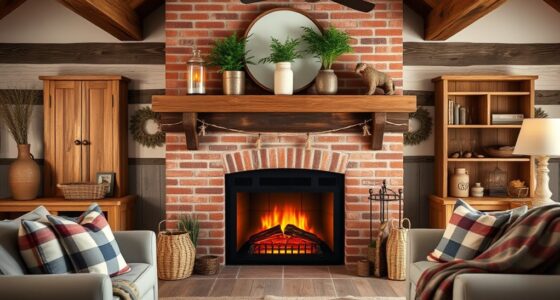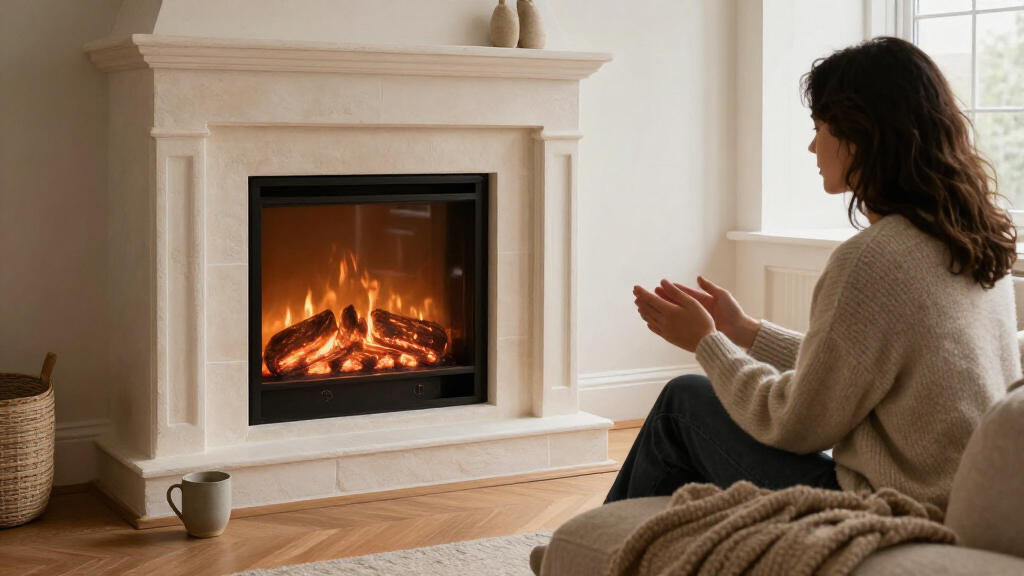
Choosing an electric fireplace for a living room usually comes down to a practical tradeoff: do you want to reuse an existing fireplace opening, or add a focal point where none exists? Electric fireplace inserts fit into a suitable existing hearth and tend to look more integrated. Wall-mounted electric fireplaces attach to a wall, giving you more freedom over placement and avoiding the need for a fireplace opening.

Get home appliances delivered free with Prime
- Fast, free delivery on millions of items
- Prime Video, Amazon Music and more included
- Member-only deals all year

HOMCOM 32-Inch Freestanding Electric Fireplace Mantel, 1400W, Brown
- ✔ Power: 1,400 W
- ✔ Heat output: 5,100 BTU
- ✔ Listed coverage: Up to 323 sq. ft.

Silonn 24-Inch Electric Corner Fireplace Heater with App and Remote
- ✔ Power: 1,400 W
- ✔ Heat output: 5,300 BTU
- ✔ Temperature range: 62°F–82°F

OLIXIS 19-Inch Freestanding Electric Fireplace Heater
- ✔ Heat settings: 750 W and 1,500 W
- ✔ Heat output: 5,110 BTU
- ✔ Listed coverage: 108 sq. ft.
Both types can provide flame effects and supplemental heat, but neither should be treated as a replacement for a home’s main heating system. An insert is generally the stronger fit for a living room with an unused, appropriately sized fireplace. A wall-mounted model suits renters or homeowners who want a simpler installation and more choice about where the fireplace goes. The right comparison is less about which style looks better in isolation and more about the room you have, the installation you can manage, and how often you expect to use the heat.
At a Glance
| Criteria | Electric fireplace inserts | Wall-mounted electric fireplaces | Winner |
|---|---|---|---|
| Room compatibility | Requires a suitable existing fireplace opening; dimensions and clearances must match the model. | Can work in rooms without a traditional fireplace, subject to wall and electrical requirements. | B |
| Installation | Slides into an existing opening; some models need added trim or electrical work. | Typically mounts to a wall; installation effort depends on the unit, wall structure and wiring. | B |
| Appearance | Often gives an unused hearth a more integrated, built-in appearance. | Creates a visible feature on the wall, with a more contemporary profile. | A |
| Placement flexibility | Limited to the location of the existing fireplace. | More flexible; can be placed on a suitable wall, within model requirements. | B |
| Supplemental heat | Useful for supplemental warmth near the hearth; output varies by model and room. | Also suited to supplemental warmth; heating performance depends on the particular unit and room. | Tie |
| Upfront value | Can be good value when the opening is already available and needs no major modification. | Often avoids the cost of creating a fireplace recess, though mounting or electrical work can add expense. | Depends |
| Moving or changing rooms | Usually harder to relocate because it is sized and fitted to a specific opening. | Generally easier to remove or replace, although the mount and wall may need attention. | B |
HOMCOM 32-Inch Freestanding Electric Fireplace Mantel, 1400W, Brown
For a living room that needs a defined visual center as well as supplemental warmth, the HOMCOM 32-Inch Mantel makes the most complete case in this group. Its mantel gives the fireplace more furniture-like presence than the freestanding Silonn corner heater or the compact OLIXIS, and provides a surface for decorations or a TV. The listed heating coverage of up to 323 square feet is also the broadest figure among these options, though it should be treated as a guide rather than a guarantee for every room.The 3D LED flame can operate independently of the quartz heater, so we can use the fireplace as ambient lighting without adding heat. Remote control, an adjustable thermostat, timer, and safety shutoff make it more convenient for a settled living-room setup than the OLIXIS, whose controls are mechanical knobs. That added scale has a real cost in flexibility: at 41.9 pounds and nearly 30 inches tall, it is much more involved to place than the lightweight OLIXIS, and two people are recommended for installation. Its 1,400W output is supplemental heat, not a substitute for a home’s primary heating system, and the stated coverage may not be enough for a large or open-plan living area.We would choose it over the Silonn when mantel presence and a larger stated coverage area matter more than app control or a corner-specific design. Skip it if floor space is tight or you want to move the heater frequently.
Pros:
- Mantel adds a display surface and a more substantial focal point.
- Flame effect can run independently from the heater.
- Remote, adjustable thermostat, timer, and safety shutoff are included.
- Listed heating coverage is up to 323 square feet.
Cons:
- At 41.9 pounds, it is less convenient to move than the OLIXIS.
- Two people are recommended for installation, and it occupies substantial floor space.
- Listed coverage may not suffice for a large or open-plan living room.
Best for: Living rooms where we want a furniture-like fireplace with a mantel surface, remote control, and a larger stated coverage area.
Not ideal for: Small or frequently rearranged rooms, or anyone expecting one freestanding heater to warm a large open-plan space as primary heat.
Bottom line: Choose the HOMCOM when living-room presence and a useful mantel surface matter more than portability or a compact footprint.
“Choose the HOMCOM when living-room presence and a useful mantel surface matter more than portability or a compact footprint.”
Silonn 24-Inch Electric Corner Fireplace Heater with App and Remote
The Silonn 24-Inch Corner Fireplace is the most control-focused option here. App and remote operation, five flame brightness levels, and an adjustable temperature range let us change the setting without reaching down to mechanical knobs. Its corner orientation gives it a clear role in a living room with an available corner, while the HOMCOM is better suited to a wall position where a mantel can serve as a focal point.At 1,400W and 5,300 BTU, it offers a comparable heat class to the other two products, but the supplied details do not state a coverage area. That makes the HOMCOM’s stated coverage of up to 323 square feet easier to use as a planning reference. Silonn does specify a 37 dB noise level, plus child lock, overheat protection, and automatic shutdown if tilted more than 45 degrees. Those safeguards may be useful in a busy household, though they do not remove the need to follow placement and operating instructions. The 1–8-hour timer is relatively limited for buyers who want longer scheduled operation, and a 24-inch unit still needs dedicated floor space. Unlike the OLIXIS, its listed features do not specify a flame-only mode.Pick the Silonn over the OLIXIS when app access and a corner fit are more important than lightweight portability. Choose the HOMCOM instead if a mantel and stated room coverage are central to the decision.
Pros:
- App and remote controls support convenient adjustments.
- Five flame brightness levels and adjustable temperature offer flexibility.
- Child lock, overheat protection, and tilt shutoff are included.
- Specified operating noise is 37 dB.
Cons:
- The 24-inch corner design needs a suitable corner and floor space.
- Timer is limited to 1–8 hours.
- Supplied details do not state heating coverage or specify flame-only operation.
Best for: Living rooms with a suitable corner and households that value app access, adjustable flame brightness, and multiple safety features.
Not ideal for: Buyers who need a stated heating coverage figure, a very small heater, or a timer longer than eight hours.
Bottom line: Choose the Silonn when corner placement and app-based adjustment are the priorities, and confirm its room fit before purchase.
“Choose the Silonn when corner placement and app-based adjustment are the priorities, and confirm its room fit before purchase.”
OLIXIS 19-Inch Freestanding Electric Fireplace Heater
When our living room has limited space or we want a heater that can be moved between spots, the OLIXIS 19-Inch is the practical pick. At 7.8 pounds, it is far easier to reposition than the 41.9-pound HOMCOM, and its 14 × 7.8 × 18.9-inch dimensions make it the least imposing choice in this lineup. The tradeoff is visual: four support legs and a compact cabinet cannot provide the mantel-style focal point offered by the HOMCOM.Two heat settings, 750W and 1,500W, give us a lower-power option as well as a higher setting, and its adjustable thermostat helps tailor operation. The product lists coverage of 108 square feet, which makes it a better fit for a modest living room or a localized seating area than the HOMCOM’s stated 323 square feet. Its flames and glowing logs can run without heat, a useful distinction from the Silonn’s supplied feature list. Mechanical knobs keep controls straightforward, though buyers seeking app access or remote operation should look to the Silonn or HOMCOM instead.Placement needs care: the heater requires a flat, stable surface, clearance from walls and flammable materials, and should not be used with an extension cord or placed on carpet. Those requirements matter in a lived-in room where outlets and rugs shape furniture placement. Choose it when small size and easy relocation outweigh a larger coverage claim and more polished controls.
Pros:
- Lightweight at 7.8 pounds and easy to relocate.
- 750W and 1,500W heat settings with adjustable thermostat.
- Flame and glowing-log effects can run without heat.
- Overheat protection and a cool outer shell are specified.
Cons:
- Listed coverage is 108 square feet, less than the HOMCOM’s stated figure.
- Requires a stable, flat surface and attached support legs.
- Must not be placed on carpet or used with an extension cord; clearance is needed.
Best for: Buyers furnishing a smaller living room or seating nook who want a lightweight unit with separate low and high heat settings.
Not ideal for: Large or open-plan living rooms, anyone seeking a mantel focal point, or buyers who need remote or app controls.
Bottom line: Choose the OLIXIS for compact supplemental warmth and portability in a smaller living room, not as a room-defining centerpiece.
“Choose the OLIXIS for compact supplemental warmth and portability in a smaller living room, not as a room-defining centerpiece.”
As an Amazon Associate we earn from qualifying purchases.
Key Differences
The biggest difference is what the room must provide. An insert needs a compatible fireplace opening, and that requirement limits both model choice and placement. In exchange, it can make an existing hearth feel purposeful without adding a new object to the wall. A wall-mounted fireplace needs a suitable wall instead, so it can serve rooms that have no hearth and gives more freedom over where the focal point sits. That flexibility is a meaningful advantage in many living rooms, though it does not remove the need to check mounting, clearance and electrical requirements.
Neither category automatically heats better. Compare the stated heat output and intended room coverage for the specific models, and think of either as supplemental warmth rather than whole-home heating. Value also depends on the starting point: using an existing fireplace opening can make an insert economical, while constructing or altering an opening can make it a more involved project. A wall-mounted model often costs less to fit when the wall and outlet are ready, but installation costs can change that calculation.
For most buyers without an existing fireplace, a wall-mounted model is the more practical starting point because it does not depend on a hearth. For a living room with a suitable unused fireplace, an insert is often the better visual match and may offer stronger value. Pay extra for either style only when its fit, finish or heat features solve a real need in your room.
Detailed Comparison
Room compatibility (Wall-mounted electric fireplaces wins — major)
A wall-mounted unit wins for reach: it can suit a living room with no fireplace opening, provided the wall and electrical setup meet the model’s requirements. An insert is limited to a suitably sized existing hearth. This is a major gap for homes without a fireplace, but no gap at all if the room already has a compatible opening.
Installation (Wall-mounted electric fireplaces wins — moderate)
Wall-mounted fireplaces usually need a secure mounting location and access to power, while inserts must fit the fireplace opening and may require trim or electrical changes. Wall-mounted models have a moderate advantage when the room is already ready for mounting. If the hearth and wiring are already suitable, an insert can be straightforward too.
Appearance (Electric fireplace inserts wins — moderate)
An insert usually wins for a living room with an unused hearth because it fills an existing architectural feature and can look integrated. A wall-mounted model reads more clearly as a separate contemporary feature. The gap is moderate and largely comes down to the room’s design: a built-in look matters most when there is already a fireplace opening.
Placement flexibility (Wall-mounted electric fireplaces wins — major)
Wall-mounted fireplaces win because they do not have to sit in the room’s existing hearth location. The freedom is still bounded by mounting and clearance rules, so measure before choosing a wall. This is a major practical advantage when the fireplace opening is badly placed, absent or not suited to an insert.
Supplemental heat (minor difference)
Neither type wins by category alone. A specific insert or wall-mounted unit may offer more heat than another model, so compare output, coverage claims and controls across the products you are considering. The gap is minor until the room’s size or heating needs make model capacity a deciding factor; neither should be assumed to heat the whole home.
Upfront value (moderate difference)
This depends on what the room already has. An insert can be good value when a compatible fireplace opening needs no major work, while a wall-mounted model can avoid the expense of building a recess. The difference is moderate: installation and electrical changes can outweigh a unit’s purchase price, so judge the complete setup cost.
Moving or changing rooms (Wall-mounted electric fireplaces wins — moderate)
A wall-mounted unit generally wins because it is less tied to one particular opening and may be removable when you move or redesign the room. Wall repair and mount removal still take effort. An insert is more specific to the dimensions and position of its hearth, making it harder to reuse elsewhere. This is a moderate difference for renters or frequent movers.
Electric fireplace inserts: Pros and Cons
Pros:
- Can give an existing, unused hearth a more integrated look.
- Makes practical use of a fireplace opening without relying on a new wall feature.
- Can offer good value when the opening and electrical setup are ready.
Cons:
- Requires a fireplace opening with compatible dimensions and clearances.
- Offers little freedom to change the fireplace’s location.
- May involve added trim, electrical work or fitting costs.
Wall-mounted electric fireplaces: Pros and Cons
Pros:
- Works in living rooms without a traditional fireplace.
- Offers more choice about where to place the focal point.
- Often avoids the work of creating a fireplace recess and can be easier to replace.
Cons:
- Needs a suitable wall, secure mounting and appropriate electrical access.
- Can look like a separate appliance rather than part of the room’s architecture.
- Installation may need extra work if wiring or the wall is not ready.
Who Should Choose What
Choose Electric fireplace inserts if:
- Your living room has an unused fireplace opening that fits the insert you want.
- You prefer a fireplace that looks integrated with an existing hearth.
- You can use the existing opening and electrical setup without major renovation.
Choose Wall-mounted electric fireplaces if:
- Your living room has no fireplace opening.
- You want more freedom to choose the fireplace’s location.
- You may move, replace the unit or change the room layout later.
Skip both if: Skip both if you need a primary heat source for a large or poorly insulated home; compare dedicated heating options for that need.
Value for Money
Paying more for an insert makes sense when it fits an existing hearth and delivers the built-in finish you want without substantial modification. If fitting one means rebuilding the opening or carrying out extensive electrical work, its apparent price advantage can disappear. A wall-mounted unit is often the better value for a room without a fireplace because it avoids creating a recess, but the total depends on mounting and wiring costs. Compare the unit, installation and any required electrical work together. Paying extra for either category is worthwhile only if you value its specific appearance, controls or heating features.
Final Verdict
For most living rooms without a fireplace opening, choose a wall-mounted electric fireplace: it offers more placement options and avoids requiring an existing hearth. Choose an insert when your room already has a suitable fireplace and an integrated finish matters more than flexibility. The biggest deciding factor is the room’s structure, followed by the complete installation cost. Neither option is a substitute for a primary heating system, so choose between them for supplemental warmth and the look you want.
Frequently Asked Questions
Which is easier to install, an insert or a wall-mounted electric fireplace?
A wall-mounted model is often simpler when the wall is suitable and power is nearby. An insert can be easy to fit into a compatible opening, but added trim, sizing issues or electrical work can make installation more involved. Check the requirements for the specific model.
Does an electric fireplace insert heat better than a wall-mounted model?
Not by category alone. Heat output varies by model, so compare the manufacturers’ output and room coverage information. Treat either type as supplemental heat rather than a replacement for central or primary heating.
Is a wall-mounted electric fireplace a good choice for a small living room?
It can be, particularly when a small room has no existing fireplace opening and a wall is available. Check the unit’s dimensions, recommended clearances and heat output against the room before buying.
Is an insert worth the extra cost?
It can be worth paying more when a compatible hearth is already in place and the integrated appearance is a priority. If the opening needs extensive alteration, compare the full project cost with a wall-mounted unit before deciding.