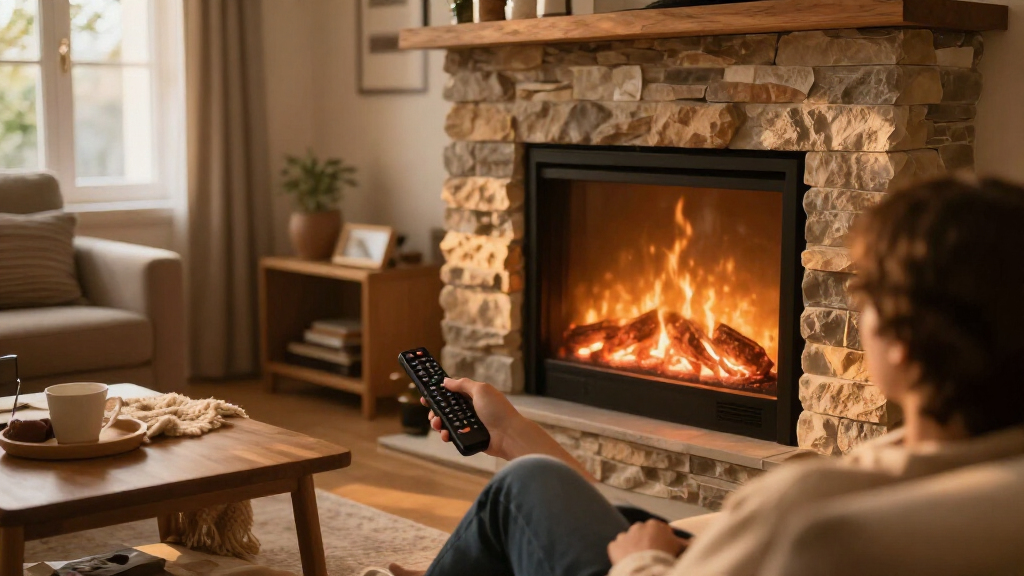

When shopping for an electric fireplace with a remote control, the main decision is usually not which handset has more buttons. It is whether you want a permanent fireplace feature or a heater that can be placed and operated with little installation. Built-in models fit into a wall or a purpose-made surround, giving the room a cleaner, more finished look. Plug-in models sit in a room or attach to a wall, so they are generally easier to set up, relocate, and buy on a tighter budget.

Get home appliances delivered free with Prime
- Fast, free delivery on millions of items
- Prime Video, Amazon Music and more included
- Member-only deals all year

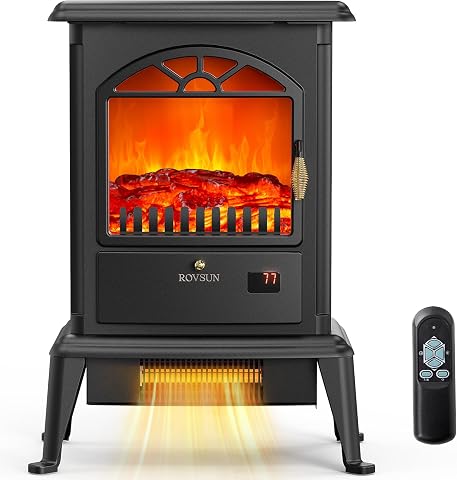
ROVSUN Freestanding Electric Fireplace Stove Heater with Remote, 7 Flame Colors and 4 Brightness Levels
- ✔ Power: 1500W
- ✔ Heating coverage: Up to 400 sq. ft.
- ✔ Heating type: Infrared quartz
Bonnlo 22.4-Inch Freestanding Electric Fireplace Heater with Remote
- ✔ Heating modes: 1,000W and 1,500W
- ✔ Thermostat: 62°F–90°F
- ✔ Heating coverage: Up to 400 sq. ft.

R.W.FLAME 25-Inch Electric Fireplace Heater with Remote, Adjustable Flames, and Log Set
- ✔ Heating power: 500W and 1500W
- ✔ Heat output: 5,100 BTU
- ✔ Heating coverage: Up to 300 sq. ft.
Both types can offer remote flame and heat controls, but the experience depends on the specific model. The practical differences are installation, room layout, heat output, feature set, and total cost. Choose built-in if appearance and a dedicated fireplace location matter most. Choose plug-in if flexibility, simpler setup, or lower upfront cost matters more.
At a Glance
| Criteria | Built-in electric fireplaces with remote control | Plug-in electric fireplaces with remote control | Winner |
|---|---|---|---|
| Installation and setup | Requires a suitable wall opening or surround; installation may need planning and professional work. | Typically plugs into a suitable outlet; wall-mounted units need secure fixing. | B |
| Room appearance | Can sit flush or appear integrated, depending on the design. | Visible as a freestanding unit or wall-mounted feature. | A |
| Placement flexibility | Best for a fixed location; moving it later takes more work. | Easier to reposition than a built-in unit, subject to cord reach and mounting type. | B |
| Heating use | Electric resistance heat suits supplemental room heating; output varies by model. | Also best treated as supplemental heat; compare wattage and room guidance. | Tie |
| Remote and flame features | Remote features vary; often includes flame and heat controls, sometimes timers or flame-only mode. | Remote features vary; common controls include heat, flame brightness, and timer settings. | Tie |
| Upfront cost and value | Usually costs more once the unit, surround, and installation are counted. | Usually lower initial cost and simpler setup, though premium designs can narrow the gap. | B |
ROVSUN Freestanding Electric Fireplace Stove Heater with Remote, 7 Flame Colors and 4 Brightness Levels
ROVSUN is our most balanced choice for buyers who want the remote to shape the room’s atmosphere as much as its warmth. It offers seven flame colors and four brightness levels, alongside an adjustable temperature and timer. Because the flame effect can run without heat, we can use the visual display across seasons rather than treating it only as a heater. That gives it an edge over Bonnlo, whose listed strengths center more on heating modes, thermostat control, and timer convenience.The stated 1500W infrared quartz heater is rated for spaces up to 400 square feet, matching Bonnlo’s coverage claim and exceeding R.W.FLAME’s 300-square-foot figure. Its freestanding iron-and-glass construction requires no assembly, and at approximately 12.3 pounds it is much lighter than the 32-pound R.W.FLAME. The tradeoff is that ROVSUN’s provided specifications do not list multiple wattage modes, while Bonnlo and R.W.FLAME explicitly offer lower-power settings. Its coverage is also supplemental and limited to the stated room size, and placement still depends on access to an AC outlet.
Pros:
- Seven flame colors and four brightness levels offer varied visual settings.
- Flame effect can run with or without heat.
- Remote controls temperature, flame, brightness, and timer settings.
- Freestanding design needs no assembly and includes overheat and tip-over protection.
Cons:
- Heating coverage is stated for spaces up to 400 square feet and is supplemental.
- Requires an AC power connection.
- Specifications list a single 1500W heating power rather than selectable wattage modes.
Best for: Buyers who want a remote to adjust flame color and brightness, and who value a flame-only setting alongside supplemental heat.
Not ideal for: People seeking multiple heating power modes, a cordless fireplace, or primary heat for a space larger than the stated coverage.
Bottom line: ROVSUN is our best all-around pick when remote flame customization and year-round flame-only use matter most.
“ROVSUN is our best all-around pick when remote flame customization and year-round flame-only use matter most.”
Bonnlo 22.4-Inch Freestanding Electric Fireplace Heater with Remote
Bonnlo is a sensible choice for buyers who prioritize heating control and a compact, lighter unit over elaborate flame customization. Its 1,000W and 1,500W modes let us choose between two levels of output, while the thermostat adjusts from 62°F to 90°F. That makes its heating setup more explicit than ROVSUN’s listed single 1500W power rating. It also shares ROVSUN’s stated coverage of up to 400 square feet and adds a 0–12-hour timer.The fireplace weighs 12.5 pounds and measures 22.4 inches high, so it is easier to place or move than the 32-pound R.W.FLAME. Its below-40-dB operation may appeal in living areas where a noisy heater would be distracting. The remote and timer simplify adjustment from a seat, and safety features include overheat protection and automatic shutoff when tilted more than 45 degrees. Its main compromise is a more modest description of the flame effect: unlike ROVSUN’s seven colors and four brightness levels or R.W.FLAME’s adjustable flame and log colors and speed, Bonnlo’s listed specifications do not detail comparable visual controls. Buyers should also account for the remote’s AAA batteries and indoor-only use.
Pros:
- Two heat modes, 1,000W and 1,500W, plus an adjustable thermostat.
- Remote and 0–12-hour timer support convenient operation.
- Stated coverage up to 400 square feet and noise below 40 dB.
- Overheat protection and tilt-triggered automatic shutoff.
Cons:
- AAA batteries are required for the remote.
- Intended for indoor use and requires AC power.
- Flame customization details are less extensive than the ROVSUN and R.W.FLAME listings.
Best for: Buyers who want selectable heat modes, a thermostat, a timer, and a relatively light freestanding fireplace for indoor use.
Not ideal for: Shoppers who want detailed flame and log customization, or who need a fireplace without battery-dependent remote operation.
Bottom line: Bonnlo is our practical choice for buyers who want two heat settings and a timer in a light, compact unit.
“Bonnlo is our practical choice for buyers who want two heat settings and a timer in a light, compact unit.”
R.W.FLAME 25-Inch Electric Fireplace Heater with Remote, Adjustable Flames, and Log Set
R.W.FLAME is the visual-control pick for buyers who want to tune more than just flame brightness. Its remote supports adjustment of flame color, log color, brightness, and speed, while separate flame and heating controls make it possible to manage the display and warmth independently. Compared with Bonnlo, which is described around its two heating modes and thermostat, this model puts more emphasis on the look of the fire. It also offers 500W and 1500W settings, giving it a lower-output option that ROVSUN’s listed single-power specification does not provide.That customization comes with a different physical tradeoff. At 32 pounds, R.W.FLAME is far heavier than the roughly 12-pound ROVSUN and Bonnlo units, so it is better suited to a chosen spot than frequent repositioning. Its stated heating coverage is up to 300 square feet, below the 400-square-foot figures given for the other two. The 25-inch cathedral-style design may be a fit where buyers want a more substantial freestanding presence, but the heavier build and lower coverage claim make it less versatile as a room-to-room supplemental heater. It requires corded electric power and includes overheating protection.
Pros:
- Remote adjusts flame and log colors, brightness, and speed.
- Separate flame and heating controls provide independent operation.
- Two heat settings: 500W and 1500W.
- Freestanding iron-and-glass design with overheating protection.
Cons:
- Stated heating coverage is up to 300 square feet, less than the other two models.
- At 32 pounds, it is substantially heavier than ROVSUN and Bonnlo.
- Requires a corded electric power source.
Best for: Buyers who value fine control over flame and log appearance and want both 500W and 1500W heat settings.
Not ideal for: People who need a lightweight unit, the largest stated heating coverage, or a fireplace they plan to move often.
Bottom line: R.W.FLAME is the specialist choice for detailed visual adjustments and dual heat settings, provided its weight and coverage fit the room.
“R.W.FLAME is the specialist choice for detailed visual adjustments and dual heat settings, provided its weight and coverage fit the room.”
As an Amazon Associate we earn from qualifying purchases.
Key Differences
The biggest tradeoff is permanence versus flexibility. A built-in unit can make a wall look like it was designed around a fireplace, which suits renovations or rooms where the fireplace will stay in one place. That finish comes with planning, measurements, and possible installation costs. A plug-in model can be ready with less work and is easier to take to another room or home, but its body, cord, or wall mounting remains part of the room’s visible setup.
Heating and remote control are less reliable ways to distinguish the categories. Both can provide supplemental electric heat and remote operation, but neither category guarantees a particular output, thermostat, timer, or flame effect. Check the model specifications and safety instructions. Paying extra for a built-in look makes sense when the installation and appearance are part of a broader room plan. If you mainly want convenient flame effects and occasional warmth, a suitable plug-in unit is usually the better value.
Detailed Comparison
Installation and setup (Plug-in electric fireplaces with remote control wins — moderate)
Plug-in fireplaces win by a moderate margin for setup. Many freestanding models only need a suitable outlet and clear space, while a wall-mounted version still needs secure attachment. Built-in models need a compatible opening or surround, and the work can involve planning the wall and arranging installation. The difference matters most if you rent, want a quick room update, or do not want construction work.
Room appearance (Built-in electric fireplaces with remote control wins — moderate)
Built-in fireplaces win by a moderate margin when a seamless finish is the goal. They can sit within a wall or fitted surround and read as a permanent architectural feature. Plug-in units are more visible as appliances, although a carefully chosen wall-mounted or furniture-style model can still look deliberate. The visual advantage is meaningful in a planned renovation, but less important in a casual living space.
Placement flexibility (Plug-in electric fireplaces with remote control wins — major)
Plug-in models win by a major margin for flexibility. A freestanding unit can be repositioned when the layout changes, and it may be easier to move to a new home. A built-in fireplace is tied to its opening and surrounding finish. Wall-mounted plug-in models are less movable than freestanding ones, so check the mounting requirements before choosing.
Heating use (minor difference)
This is generally a tie between the categories. Both use electricity for supplemental heat, and the useful area depends on the model’s output, room conditions, and how the manufacturer describes coverage. Neither should be assumed to replace a home’s main heating system. Compare wattage, thermostat controls, and guidance for your room rather than assuming a built-in model heats better.
Remote and flame features (moderate difference)
There is no dependable category winner. Some remotes control heat and flame brightness separately; others add a timer, thermostat, or flame-only operation. These differences are model-specific, so a less expensive plug-in unit may have the controls you need while a built-in unit may not. Check whether the remote controls the functions you care about and whether the heater can be switched off while the flame effect remains on.
Upfront cost and value (Plug-in electric fireplaces with remote control wins — moderate)
Plug-in models usually win on upfront value by a moderate margin because they avoid much of the added cost and work associated with a fitted installation. That does not make every plug-in unit inexpensive: decorative surrounds and premium designs can raise the price. A built-in model’s higher total cost can be justified if the finished appearance is a central part of a renovation. If ease and occasional use are the priorities, paying more for a permanent installation is hard to justify.
Built-in electric fireplaces with remote control: Pros and Cons
Pros:
- Creates a more integrated fireplace feature.
- Works well in a planned renovation or a room with a dedicated fireplace location.
- Can keep the appliance body less prominent in the finished room.
Cons:
- Needs a compatible opening or surround and more installation planning.
- Costs more when fitting and finishing are included.
- Is difficult to relocate if the room layout or home changes.
Plug-in electric fireplaces with remote control: Pros and Cons
Pros:
- Usually simpler to set up, especially in freestanding form.
- Offers more flexibility if you rearrange rooms or move home.
- Often provides better value when the goal is flame effects and supplemental heat.
Cons:
- The unit, cord, or wall mounting may be more visible.
- Freestanding models need floor space; wall-mounted models need secure fixing.
- Looks and build quality vary widely, so a low price alone is not a good guide.
Who Should Choose What
Choose Built-in electric fireplaces with remote control if:
- You are renovating and want the fireplace to look built into the room.
- You have a permanent location and are comfortable paying for fitting and finishing.
- A clean, integrated appearance matters more than the ability to move the unit.
Choose Plug-in electric fireplaces with remote control if:
- You want a straightforward setup with little or no construction.
- You may rearrange your room or move home.
- You want remote flame effects and occasional supplemental warmth at a lower total cost.
Skip both if: You need primary whole-home heating, or the room lacks a safe placement and suitable electrical supply for the models you are considering.
Value for Money
For most shoppers who want ambience and occasional room heat, a plug-in fireplace is the better value. Its lower setup burden leaves more of the budget available for the features that affect daily use, such as a thermostat, timer, flame-only mode, or adjustable brightness. Paying more for a built-in model is worthwhile when it completes a renovation or delivers an integrated look you value enough to keep for years. Count the unit, surround, installation, and any finishing work before comparing prices. A premium plug-in model can also cost more, so compare total cost and controls rather than relying on category alone.
Final Verdict
Choose a plug-in electric fireplace with remote control if you want convenient flame effects, flexible placement, and supplemental heat without a larger installation project. For most households making a practical purchase, it is the stronger value. Choose a built-in model when the fireplace is part of a room renovation and the integrated appearance justifies the extra cost and fixed location. The deciding factor is permanence: pay more for built-in only when the finished wall feature matters more to you than easy setup and future flexibility.
Frequently Asked Questions
Do all electric fireplaces with remote control include a heater?
No. Check the product specifications: some models provide flame effects without heat, while others include a heater. If you want warmth, confirm the output and recommended room use.
Can I use the flame effect without heat?
Many models offer a flame-only setting, but it is not universal. Confirm that the remote or controls let you turn off the heater independently if this matters to you.
Is a built-in electric fireplace warmer than a plug-in one?
Not by category alone. Heating performance depends on the individual model and its output, not simply whether it is built in or plugs in. Compare specifications and use the heater as directed.
Is a plug-in electric fireplace suitable for an apartment?
A freestanding plug-in model may suit an apartment if the outlet, placement, and building rules allow it. Wall-mounted models require secure fixing, and renters should check whether mounting is permitted.