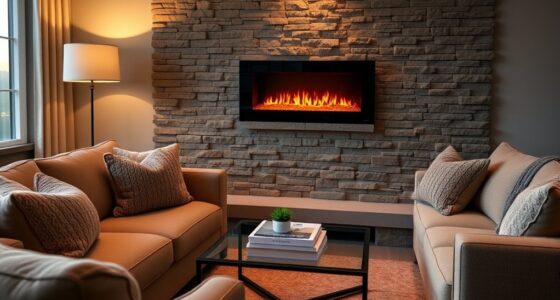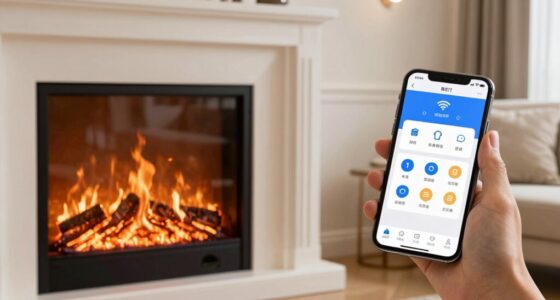

When comparing electric fireplaces with remote control, the first decision is usually not which remote has more buttons. It is whether you want a heater and flame effect you can set up with little disruption, or a fireplace integrated into a wall or surround. Plug-in electric fireplaces with remotes typically need a suitable outlet and clear floor space; built-in models are designed to sit within a prepared opening and look more like part of the room.

Get home appliances delivered free — and shop member deals
- Fast, free delivery on millions of items
- Access to Prime Big Deal Days deals on October 6–7
- Prime Video, Amazon Music and more included

Silonn 24-Inch Electric Corner Fireplace Heater with App and Remote
- ✔ Power: 1,400 W
- ✔ Heat output: 4,777 BTU
- ✔ Temperature range: 62°F–82°F
Bonnlo 22.4-Inch Freestanding Electric Fireplace Heater with Remote
- ✔ Dimensions: 10.7 × 16.6 × 22.4 in (D × W × H)
- ✔ Weight: 12.5 lb
- ✔ Heating modes: 1,000W and 1,500W

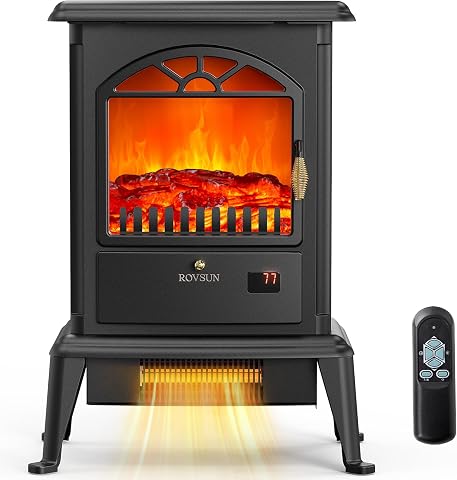
ROVSUN 22.4-Inch Electric Fireplace Stove Heater with Remote
- ✔ Power: 1,500 W
- ✔ Heating coverage: Up to 400 sq. ft.
- ✔ Temperature range: 62°F–90°F
Both types can let you adjust flame effects and heat from across the room, and either may offer features such as a thermostat or timer, depending on the model. The real tradeoff is convenience and flexibility versus a cleaner, more permanent installation. Choose a plug-in unit if you rent, want to spend less upfront, or may rearrange rooms. Choose a built-in unit if appearance and a fitted finish matter enough to justify planning, installation, and a larger budget. This comparison focuses on the format—not a claim that every fireplace in either category shares identical heating performance or controls.
At a Glance
| Criteria | Plug-in electric fireplace with remote control | Built-in electric fireplace with remote control | Winner |
|---|---|---|---|
| Installation | Usually place near a suitable outlet and plug in; follow the model’s clearance and electrical instructions. | Requires a suitable opening or surround, careful fit, and possibly electrical or building work. | A |
| Upfront cost | Usually lower overall setup cost because major building work is not part of the purchase. | Typically higher total cost once the unit, preparation, and installation are included. | A |
| Room flexibility | Can often be moved, though weight, cord placement, and outlet access can limit relocation. | Stays in its installed location; moving it may require further work. | A |
| Finished appearance | Visible unit may sit on the floor, hang on a wall, or stand in a media console; fit varies by design. | Can create a more integrated, built-in look when the opening and trim are well planned. | B |
| Heating use | Useful for supplemental warmth in the area around the unit; capacity depends on the specific model and room. | Can provide supplemental warmth like a plug-in model; output and suitability depend on the unit and room. | Depends |
| Remote-control convenience | Remote commonly handles basic flame and heat settings; included functions vary by model. | Remote convenience can be similar, but controls and features are model-specific rather than guaranteed by installation type. | Tie |
| Commitment and maintenance | Less commitment; keep vents clear, manage the cord safely, and check the unit’s care instructions. | More permanent; access for cleaning or servicing should be planned around the installation. | A |
Silonn 24-Inch Electric Corner Fireplace Heater with App and Remote
For buyers who want more ways to make adjustments without walking over to the heater, the Silonn is our most versatile remote-control pick. It includes both a handheld remote and app control, unlike the Bonnlo and ROVSUN, which list remote and onboard controls but no app. That extra control route is useful when the remote is misplaced or a phone is already at hand, although app capability alone does not establish smart-home integration beyond the stated controls.The Silonn combines 1,400W of heat with five flame-brightness settings and a listed noise level of 37 dB. Its corner orientation gives it a more specific placement role than the similarly sized freestanding Bonnlo and ROVSUN: it is intended to sit in a corner rather than simply occupy any open floor spot. The 1–8-hour timer is more limited than the other two models’ 0–12-hour timers, and its thermostat range ends at 82°F rather than 90°F. That makes Bonnlo or ROVSUN the stronger choice if broader temperature adjustment or longer timer settings are priorities.Safety features include overheat protection, a child lock, and automatic shutoff when tilted beyond 45 degrees. This is the only option here whose supplied specs list a child lock, which can matter in a busy household. Its main compromise is that we should view it as an indoor supplemental heater, not a solution for every heating need: the available description does not state room coverage, and the limited thermostat range may not suit buyers seeking higher settings. For remote flexibility and quiet operation, though, it has the most distinctive mix in this group.
Pros:
- Offers both app and handheld remote control.
- Five brightness settings let us adjust the flame effect.
- Listed 37 dB operation is the quietest stated level in this comparison.
- Includes child lock, overheat protection, and tilt shutoff.
Cons:
- Temperature range is limited to 62°F–82°F.
- Timer tops out at eight hours, shorter than the Bonnlo and ROVSUN timers.
- Supplied specifications do not state a heating-coverage area.
Best for: Buyers who want both app and handheld remote control, a corner-friendly freestanding design, and a listed 37 dB operating level.
Not ideal for: Shoppers who need a thermostat setting above 82°F, a timer longer than eight hours, or a stated room-coverage figure.
Bottom line: Choose the Silonn for the most flexible remote operation and added child-lock protection, provided its narrower thermostat range fits your needs.
“Choose the Silonn for the most flexible remote operation and added child-lock protection, provided its narrower thermostat range fits your needs.”
Bonnlo 22.4-Inch Freestanding Electric Fireplace Heater with Remote
The Bonnlo is the practical pick when we care more about controlling heat than expanding flame effects. Its two heating modes—1,000W and 1,500W—and 62°F–90°F thermostat range give it a broader stated temperature span than the Silonn. The ROVSUN also reaches 90°F, but Bonnlo makes its two power modes explicit, which can help buyers choose between a lower setting and full output rather than relying only on a target thermostat setting.Its remote operates alongside a 0–12-hour timer, matching ROVSUN’s maximum timer length and extending beyond Silonn’s eight-hour limit. The freestanding unit requires no assembly according to the supplied description, and its 12.5-pound weight makes it a portable option for moving between suitable rooms. It is rated to cover up to 400 square feet, as is the ROVSUN; those figures are useful for comparison, but room layout and insulation can affect how evenly a heater warms a space.Where Bonnlo is less compelling is ambience control. The supplied specs mention a flame effect but do not list color choices or brightness levels, so buyers who want to tune the look should favor the ROVSUN’s seven colors and four brightness settings. It also lacks Silonn’s app control and child lock. Bonnlo does include overheat and tip-over protection, and operates below 40 dB, but it requires an AC outlet and AAA batteries for the remote. We would choose it for straightforward heat adjustment and timer flexibility, not for the most customizable fireplace display.
Pros:
- Provides 1,000W and 1,500W heating modes.
- Thermostat range extends from 62°F to 90°F.
- Remote control and a 0–12-hour timer are included.
- Lists coverage up to 400 sq. ft. and operation below 40 dB.
Cons:
- Requires an AC outlet and AAA batteries for the remote.
- No app control is listed.
- Flame color and brightness adjustment details are not specified.
Best for: Buyers who want two heating modes, a thermostat adjustable up to 90°F, and a timer that can run as long as 12 hours.
Not ideal for: Shoppers seeking app control, listed flame-color and brightness adjustments, or Silonn’s child-lock feature.
Bottom line: Pick the Bonnlo over the Silonn when a wider thermostat range and longer timer matter more than app control or detailed flame customization.
“Pick the Bonnlo over the Silonn when a wider thermostat range and longer timer matter more than app control or detailed flame customization.”
ROVSUN 22.4-Inch Electric Fireplace Stove Heater with Remote
ROVSUN makes the strongest case for buyers who use a fireplace mainly to shape the room’s atmosphere as well as provide supplemental warmth. Its seven flame colors and four brightness levels give us more explicit control over the display than the Bonnlo, whose supplied details do not list those adjustments. A particularly useful distinction is that the flame effect can run with or without heat. We can keep the visual effect on when warming the room is unnecessary, a flexibility not specified for the other two models.Like Bonnlo, ROVSUN offers a 62°F–90°F temperature range, a 0–12-hour timer, and stated coverage up to 400 square feet. It has 1,500W of power and a remote plus control-panel operation. Compared with Silonn, it trades app control and the listed 37 dB noise level for deeper flame customization and a longer timer. Its approximately 40 dB noise figure is still described as low-noise, but it is higher than Silonn’s stated level; buyers who are especially sensitive to sound may prefer the Silonn.Overheat and tip-over protection are included, and the supplied specs list ETL certification. The unit is freestanding and needs a power outlet, so it still requires thoughtful placement and nearby power access. ROVSUN is not the best choice for someone who wants phone-based operation, and its coverage remains limited to spaces up to 400 square feet according to the listing. But for shoppers who want remote convenience without giving up a highly adjustable flame effect, it fills a role neither competitor matches as clearly.
Pros:
- Offers seven flame colors and four brightness levels.
- Flame effect operates with or without heat.
- Includes remote control, control-panel operation, and a 0–12-hour timer.
- Lists overheat and tip-over protection and ETL certification.
Cons:
- Requires a power outlet and does not list app control.
- Coverage is stated as up to 400 sq. ft.
- Approximately 40 dB is louder on paper than Silonn’s listed 37 dB.
Best for: Buyers who want remote operation, seven flame colors, adjustable brightness, and the ability to enjoy the flame effect without heat.
Not ideal for: Shoppers who prioritize app control, the quietest listed operation, or heating beyond the stated coverage of up to 400 sq. ft.
Bottom line: Choose ROVSUN when flame variety and heat-independent ambience matter more than app access or the lowest stated noise level.
“Choose ROVSUN when flame variety and heat-independent ambience matter more than app access or the lowest stated noise level.”
As an Amazon Associate we earn from qualifying purchases.
Key Differences
The clearest gap is how much the fireplace changes the room before you can use it. A plug-in model is usually the simpler purchase: choose a location, check the electrical and clearance requirements, and set it up as directed. That can make it a better fit for renters, households testing whether they will use a fireplace often, or anyone who does not want construction. The tradeoff is that the unit remains a visible object, and the cord and nearby outlet need a sensible, safe arrangement.
A built-in fireplace is a better choice when the finished room matters more than portability. It can sit within a planned wall opening or surround, avoiding the freestanding-appliance look. But its apparent neatness depends on accurate dimensions, access, and proper installation; a poor fit can erase the visual benefit. It also costs more in many cases once preparation and labor are counted. Remote control does not settle the choice: both formats can offer remote operation, while the specific controls, heat settings, timers, and flame options depend on the product.
For heat, do not assume built-in means more powerful or plug-in means weak. Compare each model’s stated output, electrical requirements, and room guidance, and treat either type as supplemental heat unless the manufacturer specifies otherwise. If a remote is a must-have, verify that it is included and what it controls. The smarter purchase is the fireplace whose installation, output, and features match your room—not simply the one with the most polished product photos.
Detailed Comparison
Installation (Plug-in electric fireplace with remote control wins — major)
Plug-in wins; the gap is major. A plug-in fireplace generally avoids preparing a wall opening, so setup is less involved for someone whose room is already finished. You still need to follow the unit’s electrical, clearance, and placement instructions. A built-in model calls for a correctly sized opening or surround and may need professional work. In practice, choose plug-in for a fast, lower-disruption setup; choose built-in only when you are ready to plan the installation rather than treat it as an appliance drop-in.
Upfront cost (Plug-in electric fireplace with remote control wins — moderate)
Plug-in usually wins; the gap is moderate to major. Its total cost is more predictable because extensive installation is less likely. A built-in model may carry a higher unit price and additional costs for framing, finishing, and labor. The difference depends on the product and the room: an existing suitable opening can reduce built-in costs, while custom work can raise them. Pay the premium when the fitted appearance is a real priority, not merely because the unit includes a remote.
Room flexibility (Plug-in electric fireplace with remote control wins — major)
Plug-in wins; the gap is major for renters and movers. It can usually be relocated without undoing a permanent installation, provided the new spot meets the manufacturer’s requirements and has appropriate outlet access. A built-in stays where it is, so a room redesign or move makes it harder to take the fireplace along. The plug-in’s flexibility is not unlimited: it can be bulky, and cords should not be routed in unsafe ways.
Finished appearance (Built-in electric fireplace with remote control wins — moderate)
Built-in wins; the gap is moderate to major, depending on the room. A well-planned built-in can look integrated with the wall or surround, while a plug-in unit remains a separate object even when its design is attractive. That distinction matters in a carefully finished living room, but less in a casual space, bedroom, or media room where a console or wall-mounted unit fits the decor. Built-in appearance is only a win if the opening, trim, and proportions are executed well.
Heating use (moderate difference)
Depends; there is no reliable winner by format alone. Either type may provide supplemental heat, but the actual output and suitable room size are product-specific. Compare stated heating capacity and electrical requirements rather than using installation style as a proxy for warmth. For everyday use, consider whether you want to warm the area near the fireplace or expect it to heat a larger space. Neither category should be treated as a substitute for a home’s primary heating system unless the product information supports that use.
Remote-control convenience (minor difference)
Tie; the gap is minor at the category level. Both plug-in and built-in fireplaces may be supplied with a remote, and either can make it easier to adjust flame or heat settings from a seat. The format does not tell you whether the remote controls a thermostat, timer, brightness, or other settings. Check the exact feature list and whether the remote is included. If convenient operation is the priority, compare controls model by model instead of paying extra for built-in installation.
Commitment and upkeep (Plug-in electric fireplace with remote control wins — moderate)
Plug-in wins; the gap is moderate. With no permanent opening to work around, a plug-in unit is easier to reposition or remove. Both types still need the care stated by their manufacturers, such as keeping air inlets clear and maintaining access for cleaning. A built-in installation can make servicing less convenient if the opening does not allow practical access. Plan for access before installation; do not seal a unit into a space contrary to its instructions.
Plug-in electric fireplace with remote control: Pros and Cons
Pros:
- Usually simpler to set up than a built-in fireplace.
- Lower overall cost is more likely when no construction is needed.
- Can be relocated or removed more easily.
- A sensible fit for renters or households unsure about a permanent fireplace.
Cons:
- The unit remains visible rather than becoming part of the wall.
- Needs a suitable outlet and safe cord placement.
- A freestanding design can take up floor space.
- Remote functions and heating capacity vary by model.
Built-in electric fireplace with remote control: Pros and Cons
Pros:
- Can deliver a more integrated appearance in a planned room design.
- Keeps a freestanding appliance out of the way when properly installed.
- May suit renovations where an opening or surround is already being built.
Cons:
- Usually requires more planning and installation work.
- Total cost can rise with custom preparation and labor.
- Stays in place and is harder to move or remove.
- Remote operation does not automatically mean better heat or more features.
Who Should Choose What
Choose Plug-in electric fireplace with remote control if:
- You rent, expect to move, or want to avoid altering a wall.
- You want a lower-cost fireplace that is relatively straightforward to set up.
- You want to try a remote-controlled electric fireplace before committing to a permanent feature.
- The room has a suitable location and outlet, and a visible appliance fits your decor.
Choose Built-in electric fireplace with remote control if:
- You are renovating or have a suitable opening and want a fitted finish.
- A built-in appearance matters more to you than portability or the lowest total cost.
- You expect to keep the fireplace in the same place and can plan for installation and service access.
Skip both if: Neither format fits if you need a primary heating system, cannot meet the unit’s electrical or clearance requirements, or cannot install it safely in the available space.
Value for Money
For most shoppers, a plug-in fireplace is the better value if the main goal is remote-controlled flame effects and supplemental warmth without construction. You avoid paying for a permanent finish that may not improve everyday use, and you retain the option to move the unit. That value depends on choosing a model suited to the room and checking its actual controls and output; a low purchase price is not useful if it cannot meet your needs.
Pay more for a built-in model when its integrated appearance is central to a renovation or long-term room plan. Count the fireplace, opening preparation, finishing, and labor—not just the unit’s sticker price. If the only reason for paying more is to get a remote, compare other models first: remote control is available across both formats, and the exact feature set varies. A built-in premium is worthwhile for design and permanence, not as a general guarantee of stronger heat or better controls.
Final Verdict
Choose a plug-in electric fireplace with a remote if you want the practical, lower-commitment option. For most households comparing these formats, it offers the stronger value: remote operation is available without committing to wall work, and the unit can be moved or removed more easily. Choose a built-in fireplace if you are planning a lasting renovation and want the fireplace to read as part of the room rather than as a separate appliance.
The deciding factor is installation, not the remote. Before buying either type, confirm the required electrical supply, clearance, heating guidance, and which functions the remote actually controls. If you are not ready to invest in an opening and a finished surround, do not pay the built-in premium; if an integrated look is a firm design goal, a plug-in unit may feel like a compromise even when it saves money.
Frequently Asked Questions
Do plug-in and built-in electric fireplaces both come with remotes?
Many models in both categories offer remote controls, but inclusion and functions vary. Check the exact product listing to see whether the remote is included and whether it operates the flame effect, heat, thermostat, timer, or other settings.
Does a built-in electric fireplace heat better than a plug-in model?
Not necessarily. Heating output depends on the specific fireplace, its electrical requirements, and the room—not simply whether it is built-in or plug-in. Compare the stated output and manufacturer’s room guidance for the models you are considering.
Is a plug-in electric fireplace suitable for an apartment?
It may be a practical choice because it usually avoids permanent wall work, but confirm the lease rules, outlet requirements, clearances, and placement instructions. A plug-in unit still needs a safe location and cord arrangement.
When is a built-in electric fireplace worth the extra cost?
It is worth paying more when a fitted appearance is a priority and the room project can accommodate the opening, installation, and access needed for service. If you mainly want remote operation and supplemental warmth, a plug-in model is often better value.
Halloween Picks
halloween
As an affiliate, we earn on qualifying purchases.