


Get home appliances delivered free with Prime
- Fast, free delivery on millions of items
- Prime Video, Amazon Music and more included
- Member-only deals all year
Nest Learning Thermostat vs ecobee Smart Thermostat Premium for heating
These thermostats are often compared because both can automate a home’s heating schedule, adjust settings remotely, and reduce the need to manage temperature manually. The real choice is how you want that automation to work. Google Nest Learning Thermostat centers on learning the household’s patterns and adapting its schedule. ecobee Smart Thermostat Premium centers on room sensors and settings that can prioritize occupied spaces.

ecobee Smart Thermostat Essential – WiFi Thermostat, Energy Star Certified
- ✔ Controller support: Alexa, Android, Apple HomeKit, Google Assistant, iOS
- ✔ Display: 3.74-inch LCD color touchscreen
- ✔ Connectivity: Wi-Fi

Google Nest Thermostat – Smart Wi‑Fi Thermostat
- ✔ Controller support: Google Assistant, Alexa, Android, iOS, Nest
- ✔ Display: 1.07-inch LCD
- ✔ Connectivity: Wi-Fi, 2.4 GHz and 5 GHz
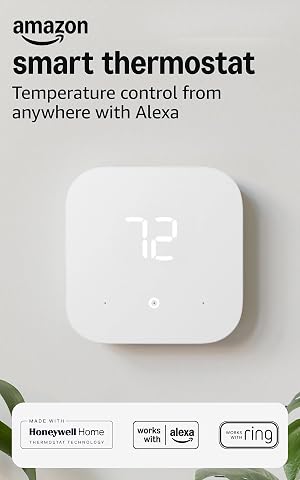
Amazon Smart Thermostat – Works with Alexa and Ring
- ✔ Model: S6ED3R
- ✔ System compatibility: Most 24V HVAC systems; not compatible with 110–240V HVAC systems
- ✔ Power: C-wire or optional power adapter kit
That distinction matters when one room is often colder than another, or when the household follows a fairly predictable routine. Nest is more appealing if you want a largely hands-off schedule and broad smart-home integration. ecobee is stronger if uneven room temperatures are a regular source of discomfort and you are willing to place and manage sensors. Both depend on heating-system compatibility, so check the wiring and equipment requirements before buying. The comparison below focuses on heating use, practical control, and whether ecobee’s additional room and air-quality features justify its higher cost.
ecobee Smart Thermostat Essential – WiFi Thermostat, Energy Star Certified
The ecobee Smart Thermostat Essential takes our top spot because it gives heating-focused households the broadest choice of connected controls in this lineup. It works with Apple HomeKit, Google Assistant, and Alexa, so choosing it does not require centering the entire home around one assistant. Its color touchscreen and app control also provide a straightforward way to adjust a schedule when voice control is not convenient.For heating comfort, the optional SmartSensors are its key differentiator. They can support room-by-room monitoring, which may help when a hallway thermostat does not reflect the temperature where people spend time. That flexibility is not included automatically: the sensors are separate accessories. The Amazon and Nest descriptions do not list the same sensor option, so ecobee has a clearer route to addressing uneven room temperatures, with an added setup and accessory decision.Power needs deserve a check before purchase. The listing describes the thermostat as battery powered and says a Power Extender Kit is optional for homes without a C-wire. That can make installation friendlier for some homes, but buyers should confirm the actual wiring and system requirements rather than treating “no C-wire required” as universal. The unit is offered in white, and the supplied details do not specify heating-system compatibility as fully as Amazon’s 24V HVAC guidance. We would verify the system match before ranking ease of installation as a certainty.Ecobee is our best overall choice for mixed-platform households or anyone who values optional room sensing. It is less compelling for buyers who want an all-in-one package with sensors included, or who want a defined compatibility list before checking their equipment. Compared with Nest, it offers more explicit cross-platform support and room-sensor expansion; compared with Amazon, it is less tightly tied to Alexa and Ring.
Pros:
- Works with Apple HomeKit, Google Assistant, and Alexa.
- Optional SmartSensors support room-by-room monitoring.
- Color touchscreen plus app control.
- Auto-Away and auto-scheduling support routine-based temperature control.
Cons:
- Power Extender Kit and SmartSensors are optional accessories.
- Available in white only.
- System compatibility and wiring should be confirmed before installation.
Best for: Households that use Apple HomeKit, Google Assistant, or Alexa and want the option to add room-by-room temperature monitoring.
Not ideal for: Buyers who want included room sensors, multiple color choices, or a clearly stated compatibility check for their specific heating equipment.
Bottom line: We recommend ecobee as the most adaptable pick for heating households that want broad smart home support and the option to add room sensing.
“We recommend ecobee as the most adaptable pick for heating households that want broad smart home support and the option to add room sensing.”
Google Nest Thermostat – Smart Wi‑Fi Thermostat
The Google Nest Thermostat is the most compact choice in this group, with a listed 1.07-inch LCD screen and controls designed around the Nest and Google Home ecosystem. It also works with Alexa, so it is not restricted to Google voice control. For buyers who prefer a smaller, simpler thermostat face and already manage their home in Google Home, Nest provides a focused alternative to ecobee’s larger color touchscreen.Its installation story is appealing but conditional. The thermostat can operate without a C-wire in most homes, which may spare some owners from adding wiring or an accessory. However, the product details specifically flag heating-only and zone-controlled systems as situations where a C-wire or additional power accessory may be needed. That caveat matters for heating buyers: compatibility should be checked against the actual system and wiring before assuming the simpler installation applies.Nest supports both 2.4 GHz and 5 GHz Wi-Fi, whereas the Amazon model is listed for 2.4 GHz only. The product also provides remote app control and alerts for HVAC issues, features that can help us notice a problem without standing at the wall. Its listed controls include button control and voice control, though voice commands still rely on a compatible assistant device and an active internet connection. Battery power is another consideration, since the listing notes periodic battery replacement.Compared with ecobee, Nest has a smaller screen and a more Google-centered experience, but its description does not specify optional room sensors. Compared with Amazon, it offers dual-band Wi-Fi and a stronger fit for Google Home users, while Amazon may feel more direct for homes already using Ring. We place Nest second because it combines broad assistant access and potentially simple wiring with system-specific qualifications that deserve extra attention.
Pros:
- Works with Google Assistant and Alexa.
- Supports 2.4 GHz and 5 GHz Wi-Fi.
- Can work without a C-wire in many homes.
- Remote app control and HVAC issue alerts.
Cons:
- Heating-only and zone-controlled systems may need a C-wire or power accessory.
- Battery-powered design requires periodic battery replacement.
- Voice control depends on a compatible device and internet connection.
Best for: Google Home users who want a compact thermostat, remote app control, and a chance of avoiding C-wire work on a compatible system.
Not ideal for: Owners of heating-only or zoned systems who have not confirmed power requirements, or buyers who want room sensors specified in the product details.
Bottom line: We favor Nest for Google Home households that value a compact interface and have verified their heating system can use its simpler power setup.
“We favor Nest for Google Home households that value a compact interface and have verified their heating system can use its simpler power setup.”
Amazon Smart Thermostat – Works with Alexa and Ring
For a home already built around Alexa and Ring, Amazon’s Smart Thermostat is the most natural match. It supports control through the Alexa app, and its guided installation in that app gives first-time smart thermostat buyers a clear route through setup. The product lists programmable schedules, humidity sensing, and presence-based adjustments, which can help align heating with routines instead of relying on constant manual changes.The compatibility details are more concrete than those supplied for ecobee: Amazon lists support for most 24V HVAC systems and explicitly excludes 110–240V HVAC systems. That is useful guidance, but it does not replace checking the wiring terminals and heating equipment. The product requires a C-wire or optional power adapter kit, so buyers should account for that before choosing it. Nest may avoid C-wire work in many homes, while ecobee describes an optional Power Extender Kit for homes without one.Amazon is a particularly focused option rather than the broadest one. It connects to 2.4 GHz Wi-Fi only, and the thermostat itself has no far-field microphone. Voice control therefore requires a separate Alexa device; the thermostat is not an independent voice assistant. The three touch buttons provide basic on-device adjustments, but buyers looking for a richer display or a wide choice of platform ecosystems may prefer ecobee. It also does not list optional room sensors like ecobee’s SmartSensor accessories.We rank Amazon third because its fit depends more heavily on an Alexa-centered home and on having a compatible power setup. For those households, guided setup and Ring integration are meaningful advantages; for mixed-platform users, ecobee is the more flexible choice, and for Google Home users seeking a compact interface, Nest is the more direct contender. Its ENERGY STAR certification is a useful efficiency signal, but actual heating savings depend on the home and schedule.
Pros:
- Guided DIY installation through the Alexa app.
- Integrates with Alexa and Ring.
- Includes programmable schedules, humidity sensing, and presence detection.
- ENERGY STAR certified.
Cons:
- Requires a C-wire or optional power adapter kit.
- Supports 2.4 GHz Wi-Fi only.
- Voice control requires a separate Alexa device.
Best for: Alexa and Ring households that want app-guided installation, schedules, and presence-aware heating control.
Not ideal for: Homes without a C-wire or compatible power adapter, users on 5 GHz-only Wi-Fi, and households that do not use Alexa.
Bottom line: We recommend Amazon’s thermostat for Alexa and Ring users who have compatible 24V equipment and want app-led setup with routine-based controls.
“We recommend Amazon’s thermostat for Alexa and Ring users who have compatible 24V equipment and want app-led setup with routine-based controls.”
As an Amazon Associate we earn from qualifying purchases.
At a Glance
| Criteria | Google Nest Learning Thermostat | ecobee Smart Thermostat Premium | Winner |
|---|---|---|---|
| Heating schedule | Learns patterns and adjusts a schedule automatically; schedules can also be set manually. | Uses schedules, occupancy information, and settings that users can adjust; less centered on learning a routine. | A |
| Room-by-room comfort | Optional Nest Temperature Sensors can track selected rooms, but the thermostat does not include one. | Includes a SmartSensor and can use sensors to prioritize occupied rooms for comfort. | B |
| Installation and compatibility | Works with many common systems; compatibility and required wiring vary by setup. | Supports many systems; some installations may require the included Power Extender Kit. Verify system compatibility. | Depends |
| Remote and voice control | Google Home control, app access, and voice control through supported assistants. | ecobee app and supported voice and smart-home integrations, including built-in voice features. | Depends |
| Extra comfort features | Energy-saving schedule features and system monitoring vary by equipment. | Includes air-quality monitoring and can support additional ecobee accessories, depending on setup. | B |
| Value | Usually the less expensive route if automatic scheduling is the main need. | Higher upfront cost can make sense when room sensors and added features will be used. | Depends |
Key Differences
What separates them for heating
The clearest difference is how each product addresses changing comfort needs. Nest’s learning approach is useful when daily routines repeat: it can build a schedule from household behavior, while still allowing manual adjustments. That can mean less time programming heating periods. It does not, by itself, solve a cold bedroom or a sun-warmed living room. Nest offers compatible room sensors separately, adding cost and setup if that becomes important.
ecobee puts room sensing closer to the center of the decision. Its included SmartSensor can report the temperature in another room and help the system respond to selected occupied spaces. That can improve perceived comfort when the thermostat’s hallway location does not reflect where people spend time. A sensor cannot make a radiator or furnace heat rooms evenly, though; it changes how the system responds, not the physical balance of the heating system. ecobee also costs more, so the advantage is most meaningful when the household will actually use its sensors and additional comfort functions.
For a straightforward, compatible system and a household seeking automatic routine management, Nest is the simpler value. For homes with persistent room-to-room temperature differences, ecobee is the more targeted tool. Neither should be bought on brand name alone: heating equipment, wiring, zoning, and local smart-home compatibility can change which model is practical.
Detailed Comparison
Heating schedule and automation (Google Nest Learning Thermostat wins — moderate)
Nest wins by a moderate margin for households whose routines are reasonably consistent. Its learning feature can build a schedule from repeated behavior, so users may spend less time creating time blocks themselves. ecobee offers schedules and occupancy-aware functions, but its appeal is less about learning a routine and more about giving the user control over comfort by room. For a household with regular weekday and weekend patterns, Nest can reduce setup effort; for frequent schedule changes, either system still benefits from reviewing settings rather than assuming automation will always match expectations.
ecobee wins by a major margin for homes where the thermostat’s location is a poor proxy for comfort elsewhere. The included SmartSensor can measure another room and inform heating decisions around occupied spaces. Nest can also use separate temperature sensors, but they add an extra purchase and do not make room sensing the default experience. Sensors help the system respond to a room’s reading; they do not independently heat that room or correct poor airflow, radiator balance, or insulation. If the problem is a single chilly bedroom, ecobee is the more direct out-of-box option.
Installation and system compatibility (major difference)
This is a tie until the heating system is checked. Both products support many common heating setups, but compatibility depends on equipment type, wiring, and sometimes system-specific controls. ecobee includes a Power Extender Kit for certain installations without a common wire; Nest installation needs also depend on the model and wiring. Neither should be assumed to work with every boiler, heat pump, or multi-zone arrangement. The practical winner is the model confirmed compatible with the actual system, ideally using the manufacturers’ compatibility check or an installer.
App, voice, and smart-home control (moderate difference)
The winner depends on the home’s existing platform. Nest fits naturally for households already using Google Home and its supported voice controls. ecobee supports its own app and several smart-home integrations, and the Premium model includes voice-related features that some households may find useful. Compatibility details can change and vary by assistant, region, and ecosystem. In day-to-day heating use, remote adjustment is available from either app; the more meaningful difference is whether the thermostat fits the controls already used in the home.
ecobee wins by a moderate margin if its extra features will be used. The Premium model adds air-quality monitoring and built-in voice functionality, alongside its included room sensor. Those features can make it a more useful home-comfort hub, though air monitoring is not the same as air purification and should not be treated as a substitute for a dedicated detector or ventilation assessment. Nest’s strengths are more focused on heating automation and energy-conscious scheduling. Buyers interested mainly in temperature control may get little practical benefit from ecobee’s additions.
Cost and value (moderate difference)
Nest is usually the better value for basic smart heating, a moderate difference when the extra ecobee functions would otherwise go unused. ecobee’s higher purchase cost can be justified if its included sensor addresses a real comfort problem or if the household values its other features. Compare current local prices and any required accessories: Nest’s separate sensor purchase can narrow the gap for a multi-room setup. Pay more for ecobee when its room prioritization solves a recurring issue, not simply because its feature list is longer.
Google Nest Learning Thermostat: Pros and Cons
Pros:
- Learns recurring household patterns to help automate a heating schedule.
- Good fit for Google Home households.
- Often costs less when room sensors and premium features are not needed.
- Manual schedules and remote controls remain available.
Cons:
- Room sensors are an additional purchase.
- Learning a schedule does not fix uneven heating between rooms.
- Compatibility depends on the heating equipment and wiring.
- Some households may prefer more explicit control over which room guides heating.
Pros:
- Includes a SmartSensor for comfort decisions based on another room.
- More directly addresses differences between the thermostat location and occupied rooms.
- Adds air-quality monitoring and built-in voice features.
- Power Extender Kit can help with some installations lacking a common wire.
Cons:
- Higher upfront price.
- Extra features may add little value if the household only wants scheduling.
- Room sensors need placement and configuration to be useful.
- Compatibility still depends on the heating system and installation.
Who Should Choose What
Choose Google Nest Learning Thermostat if:
- You want a thermostat that can learn a regular household routine and reduce schedule programming.
- Your heating is reasonably even across rooms and you do not need room sensors immediately.
- You already use Google Home and want a thermostat that fits that setup.
- Keeping the upfront cost lower matters more than adding air-quality or voice features.
Choose ecobee Smart Thermostat Premium if:
- One room is often colder or warmer than the thermostat’s location, and you want an included sensor to guide comfort.
- You want room-aware heating control and are willing to configure sensor placement and schedules.
- You will use the added air-quality monitoring or built-in voice features.
- The higher cost is justified by a specific comfort issue or feature you expect to use.
Skip both if: Your heating system is incompatible, your home uses controls that neither model supports well, or the main problem is poor system balancing, inadequate insulation, or a faulty boiler that a thermostat cannot repair.
Value for Money
Is ecobee worth paying more for?
For a home with consistent temperatures and a routine that Nest can learn, usually not. Nest provides smart scheduling and remote control without requiring a premium feature set, so it is the stronger value when the goal is simply to manage heating more conveniently. The money saved may matter more than features that stay unused.
Pay extra for ecobee when its included room sensor targets a recurring comfort problem, or when its added functions fit how the household uses smart-home devices. A sensor can help heating respond to a more relevant room temperature, which may make the upgrade worthwhile in a home where the hallway thermostat leaves living areas uncomfortable. If you would otherwise buy separate sensors for Nest, compare the total costs of the setups rather than just the thermostat prices. Check current pricing and compatibility before deciding, since either can shift the value calculation.
Final Verdict
Choose Google Nest Learning Thermostat for a compatible heating system, predictable routines, and a preference for automatic schedule learning at a lower typical cost. Choose ecobee Smart Thermostat Premium when room-to-room comfort is the deciding problem and its included sensor and extra features will get regular use. The biggest deciding factor is whether you need the thermostat to learn when the household heats the home or to pay closer attention to where people are. For most households with even heating and ordinary scheduling needs, Nest is the better value; for homes with persistent room differences, ecobee is worth the premium.
Frequently Asked Questions
Which thermostat is better for heating?
Nest is a strong choice for learning a regular heating schedule. ecobee is better when room temperatures differ and you want a sensor to help prioritize occupied spaces. The better model depends first on system compatibility and then on which problem matters most.
Can a smart thermostat fix a cold room?
It can help the heating system respond to a temperature measured in that room, especially when paired with a compatible sensor. It cannot independently deliver more heat or correct an undersized radiator, blocked vent, poor insulation, or system-balancing problem.
Is ecobee worth the higher price?
It can be if the included SmartSensor addresses an ongoing comfort issue or if you will use the additional features. If you only need remote control and schedule automation, Nest is generally the better value.
Should I check compatibility before buying?
Yes. Check the exact thermostat model against your heating equipment and wiring, especially for boilers, heat pumps, multi-zone systems, and installations without a common wire. If the setup is unclear, confirm it with an installer before purchase.
Fall Picks

Philips Hue Essential Starter Kit – Bridge and 4 E26 Smart Bulbs
As an affiliate, we earn on qualifying purchases.