TL;DR
Electric fireplaces with remote control let you adjust selected settings from across the room, often including flame brightness, heat, and power. Features vary by model, and the heater is generally supplemental, so check the manual, electrical requirements, safety clearances, and room coverage before you buy.
You can dim the flames and switch on warmth without leaving the sofa, but a fireplace remote does not tell you how much heat the room needs or what the unit can safely share on its circuit. Those details still live in the product specifications and manual.

Get home appliances delivered free with Prime
- Fast, free delivery on millions of items
- Prime Video, Amazon Music and more included
- Member-only deals all year
This guide explains what electric fireplaces with remote control usually let you adjust, how to estimate running costs, and what to check before choosing a freestanding, wall-mounted, insert, or built-in model. You’ll also get practical safety and setup tips, so the glow feels relaxing instead of becoming another thing to troubleshoot.
Think of the remote as a convenient control panel you can hold in one hand. The fireplace itself still needs the right location, electrical setup, clearances, and expectations about heat.
Check the exact remote functions; handheld remotes do not automatically provide app or voice control.
Confirm that flame-only operation is supported if you want the visual effect without heat.
Treat most electric fireplace heaters as supplemental and compare rated coverage with your room.
Estimate heater energy use from kilowatts, hours, and your local electricity price.
Follow model-specific clearance and electrical instructions; use a licensed electrician for electrical installation work.
What the remote can change without you leaving the couch
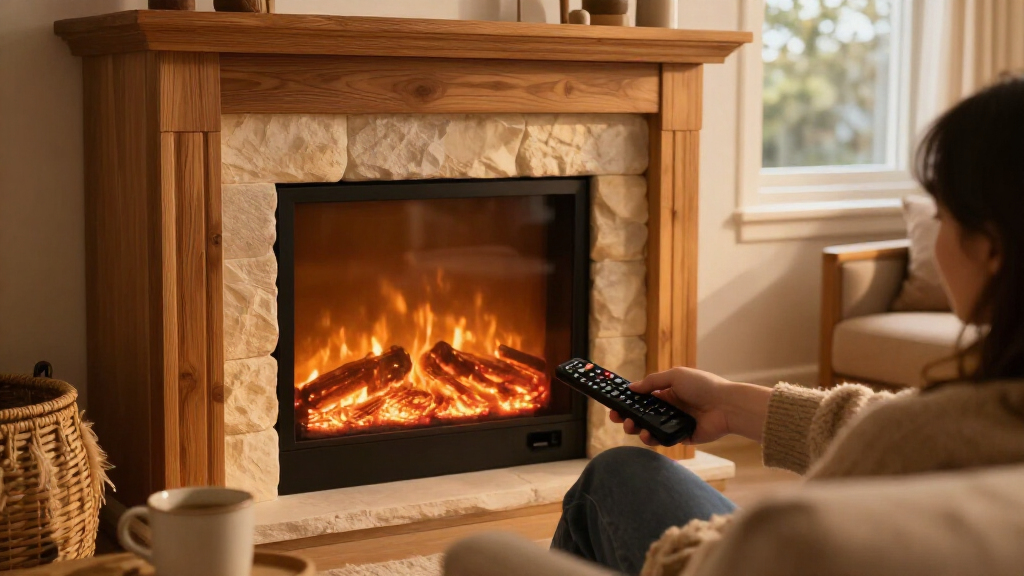
Electric fireplaces with remote control let you operate selected fireplace functions from across the room, commonly power, flame brightness, and heater settings. Some remotes also adjust a thermostat, timer, or flame color, but controls vary by model and may not include every function shown in a product photo.
That difference matters on an ordinary evening. You might use the remote to lower bright flames while watching a film, then turn the heater on when the room cools. On another model, you may need to walk over to set the timer or change a color effect because those options only appear on the unit’s control panel.
Many handheld remotes use infrared, which generally needs a reasonably clear path to the fireplace’s receiver. A coffee table, cabinet door, or person standing in the way can make the buttons seem unreliable. If you want smartphone control or voice commands, check for those features specifically: a handheld remote does not mean the fireplace connects to Wi-Fi or a smart speaker.
Before buying, compare the control list with what you’ll actually use. If you want the flame on with heat off, look for that setting in the specifications or manual; many models support it, but you should confirm. A remote offers convenience, while the model’s listed features set the limits.
Products Worth Considering

Dyson Cyclone V10 Origin Cordless Vacuum

Philips Hue Play HDMI Sync Box 8K

Philips Hue Bridge Pro Smart Lighting Hub, 1-Pack
As an affiliate, we earn on qualifying purchases.
Enjoy the glow even when you don’t need heat
Many electric fireplaces let you run the flame effect without turning on the heater, so you can enjoy the glow when the room is already comfortable. This can make the unit useful in warmer months, when a convincing ember bed and flickering flame add atmosphere without asking you to heat the room.
Imagine a cool, rainy evening in May: you want the soft orange light on the wall, but not a blast of warm air under your desk. If your model has independent flame and heat controls, you can leave the heater off. Check the manual before relying on this feature, since the control options and flame components differ by product.
Some newer models offer adjustable flame brightness and color, along with log or ember-bed designs. Those are visual features, so product photos alone can be misleading. If appearance matters to you, watch an unedited demonstration or see a unit operating in person; a static image cannot show how the flame moves or how bright it looks in a dim room.
Flame-only mode may use less electricity than heater mode, but its exact draw depends on the model. That distinction is useful if you want ambiance most nights and warmth only sometimes. Separate flame and heater controls give you more choice, but the specification sheet should confirm that they work independently.
Choose a heater for the room you actually have
An electric fireplace usually provides supplemental heat for a room or nearby area; it should not be assumed to replace your home’s main heating system. Check the manufacturer’s stated coverage and heat output, then compare them with the room’s size, insulation, ceiling height, and drafts.
For example, a unit may feel pleasant beside a reading chair in a smaller, closed room but struggle to make a large open-plan living area comfortable. A tall ceiling or chilly draft near a sliding door can also change how warmth spreads. The remote may switch the heater on from bed, but it cannot make an undersized unit warm a bigger space than it is rated for.
Use a thermostat setting, if available, to manage comfort rather than leaving the heater at maximum by habit. When you’re choosing between models, consider where the warm air exits and whether furniture could block its path. Follow the stated clearances around the unit, including distances from curtains and other materials.
The tradeoff is straightforward: more heat can help with a chilly corner, but the heater draws power and may affect what else can safely run on the same circuit. Match coverage to the space, and treat the fireplace as a local comfort source unless the manufacturer says otherwise.
Estimate the running cost before winter arrives
You can make a rough running-cost estimate with a simple formula: kilowatts × hours used × your electricity price per kilowatt-hour. A 1.5 kW heater used for two hours consumes about 3 kWh; multiply 3 by your local rate to estimate that session’s cost.
Say your electricity rate is $0.20 per kWh. Three kWh would cost about $0.60, before considering billing details or changes in the heater’s operation. A thermostat may cycle the heater off and on as the room reaches its set temperature, so actual use can differ from a calculation that assumes continuous full power.
Check the fireplace’s wattage rather than guessing from its size or appearance. A slim wall unit may have a heater, while another attractive model may focus more on the flame effect. Your usage pattern matters, too: an hour on a cool morning is a different habit from running the heater through every evening.
Use the estimate to compare your own likely routines, not as a promise of a fixed bill. Flame-only operation typically uses less power than running the heater, although the amount depends on the product. Wattage and hours drive the estimate; your local energy price turns it into a cost.
Check installation and electrical needs before you buy
Installation can range from placing a freestanding unit near a suitable outlet to mounting or fitting a wall unit, insert, or built-in fireplace. The required clearances, mounting approach, and electrical setup depend on the design, so follow the specific manufacturer instructions rather than treating every model like a plug-in appliance.
A freestanding fireplace may suit a renter who wants a movable focal point and has a suitable outlet nearby. A built-in unit can give a cleaner, fitted look, but its opening and electrical requirements need planning before installation. Electric fireplaces do not need a chimney or combustion vent, yet built-in models still have installation and clearance rules.
Check the heater’s wattage and the circuit requirements before plugging it in. Use the outlet and circuit specified by the manufacturer, and avoid extension cords unless the manual expressly permits one. If installation involves electrical work, follow local rules and use a licensed electrician; do not open or alter wiring while power is live.
It’s easy to focus on a sleek wall profile and miss the practical details. Measure the available space, note nearby outlets, and confirm any required circuit before ordering. Model-specific instructions matter, especially for mounting and electrical connections.
Keep the heater safe around kids, pets, and furniture
Electric fireplaces do not burn fuel, but their heaters, outlets, glass, or nearby surfaces can get hot. Keep the clearances listed in the manual, supervise children and pets, and never cover the fireplace or block its air intake and outlet.
Picture a curious cat stretching toward a warm spot or a toddler reaching for a glowing panel. Place the unit where people can keep a safe distance, and avoid putting toys, blankets, or pet beds close to its hot-air outlet. Built-in overheat protection and applicable safety certification are useful features to look for, but they do not replace careful placement and the manufacturer’s directions.
Before use, check that the unit sits securely and that the cord and outlet appear undamaged. Keep the air openings clear of dust and nearby objects, and switch the fireplace off if you notice an unusual smell, damaged cord, or behavior that the manual identifies as a problem. For electrical faults or installation changes, consult a licensed professional.
Regular upkeep is usually simple: clean the unit as directed and replace remote batteries when needed. Flame effects may use LEDs or other components, and service options vary by model. Safe clearance and clear airflow protect both the appliance and the people sharing the room.
Use this buying checklist to compare models
Compare fireplaces by installation type, dimensions, heater output, circuit requirements, remote functions, and safety features. A price tag or dramatic product photo cannot tell you whether a unit fits your wall, warms your room, or includes the exact timer and flame settings you expect.
For instance, if you plan to use the fireplace in a bedroom, quiet operation and a timer may matter more than several flame colors. If it will sit in a busy family room, you may care more about stable placement, clear controls, and a flame effect that still looks good in daylight. Current features, certifications, warranty terms, and availability can change, so confirm them with the manufacturer before purchase.
- Measure the location and compare it with the product’s dimensions and required clearances.
- Check heat output and coverage against the room where you’ll use it.
- Read the electrical requirements and confirm the outlet or circuit is suitable.
- Confirm remote functions, including thermostat, timer, or flame-only mode if you want them.
- Review safety certification, warranty, and return terms before placing the order.
This checklist helps you compare like with like. A freestanding unit for occasional warmth and a built-in focal point answer different needs, even when their product pages use similar language. Choose based on your room and routine first; let decorative extras break a close tie.
Frequently Asked Questions
Can I use the flame effect without turning on the heat?
Many models let you run the flame effect with the heater off. Check the product specifications or manual to confirm that the controls operate independently. This can be useful when you want a glow on a mild evening without extra warmth.
Will an electric fireplace heat my whole room or home?
Most portable and wall-mounted models provide supplemental warmth for a room or nearby area, rather than heating an entire home. Check the rated coverage and consider room size, insulation, ceiling height, and drafts. A heater that feels comfortable beside a chair may not warm a large open-plan space evenly.
Can I plug an electric fireplace into a regular outlet?
Some models are designed for a standard outlet, while others have specific circuit or installation requirements. Follow the manufacturer’s electrical instructions and local rules, and avoid extension cords unless the manual explicitly permits them. Ask a licensed electrician about electrical installation or an unsuitable circuit.
Will the remote work through walls?
Many handheld remotes use infrared and need a clear path to the fireplace’s receiver. Walls, furniture, or other obstructions may prevent a command from reaching it, and range varies by model. Check the manual if the remote seems unresponsive.
Can I control the fireplace with my phone or smart speaker?
Only if the specific model lists app or smart-home control. A handheld remote alone does not indicate Wi-Fi or voice-control support. Confirm compatibility and which functions work through the app before buying.
Are electric fireplaces safe around children and pets?
They avoid an open fuel flame, but heater outlets, glass, or nearby surfaces can become hot. Keep children and pets at a safe distance, follow the stated clearances, and never cover the unit or block its airflow. Look for applicable safety certification and overheat protection, then use the fireplace as directed.
Conclusion
Choose an electric fireplace for the room you have, the heat you need, and the controls you’ll use. Read the manual and electrical requirements before you buy, then keep the required clearances once it’s installed.
The remote should make a quiet evening easier: one button, a soft glow, and warmth where you’re sitting.